


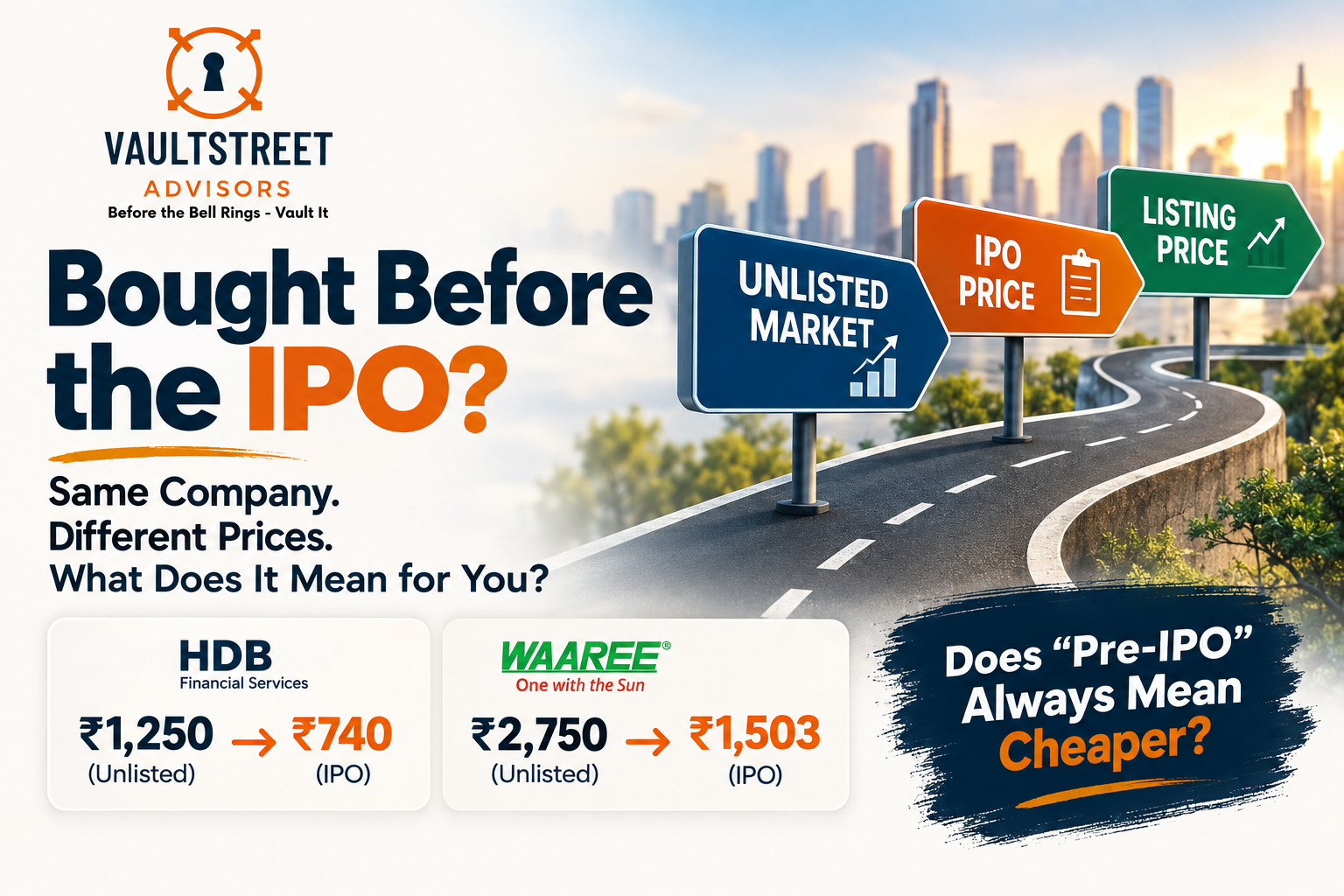
Buying before an IPO sounds like getting in early. But does “early” automatically mean “cheap”?
Not necessarily.
HDB Financial Services, NSDL, Tata Technologies, Waaree Energies, Swiggy and Studds Accessories tell an interesting story about India’s unlisted share market.
In several cases, investors were paying more in the unlisted market than the price eventually offered in the IPO.
In others, the IPO was priced sharply below the unlisted market—but the stock subsequently listed at a much higher price.
The lesson is important for anyone considering pre-IPO shares:
Buying before an IPO does not automatically mean buying at a better price. Your entry valuation matters.
If you’re new to this market, first read our guide to understanding unlisted shares.
Now let’s look at what actually happened.
Unlisted Price vs IPO Price: 6 Real Examples
| Company | Reported Unlisted Price* | IPO Price | Listing Price | What Happened? |
|---|---|---|---|---|
| HDB Financial Services | ~₹1,225–₹1,250 near IPO | ₹740 | ₹835 | IPO roughly 40% below reported unlisted level |
| NSDL | ~₹1,025 near IPO; earlier peak ~₹1,275 | ₹800 | ₹880 | Significant valuation reset before listing |
| Tata Technologies | ~₹950 | ₹500 | ₹1,200 NSE | Much lower IPO price, followed by a strong listing |
| Waaree Energies | ~₹2,700–₹2,750 | ₹1,503 | ₹2,500 NSE / ₹2,550 BSE | ~45% IPO reset followed by a strong listing |
| Swiggy | ~₹480–₹490 during Sept. 2024 pre-IPO trading | ₹390 | ₹420 NSE | IPO below the earlier reported unlisted quote |
| Studds Accessories | ₹950–₹975** | ₹585 | ₹565 NSE | Shows why the date of an unlisted quote matters |
*Unlisted-market prices are historical indicative quotations reported for the relevant periods. Unlike exchange prices, they are not continuously discovered on a public order book and can vary by date, quantity, intermediary, supply and demand.
**The ₹950–₹975 Studds quotation dates to December 2020—almost five years before its 2025 IPO. It should not be interpreted as Studds’ price immediately before the IPO.
The table reveals something investors can easily overlook:
Pre-IPO does not necessarily mean pre-discount.
HDB Financial: ₹1,250 Unlisted → ₹740 IPO → ₹835 Listing
HDB Financial Services provides one of the clearest examples.
Shortly before its IPO, HDB Financial shares were reported around ₹1,225–₹1,250 in the unlisted market.
The IPO was eventually priced at ₹740, roughly 40% below the prevailing reported unlisted level.
The shares then listed at ₹835.
Consider two hypothetical investors:
Investor A: Bought HDB Financial unlisted at ₹1,250.
Investor B: Received an IPO allotment at ₹740.
They ultimately owned shares of the same company—but Investor B entered at ₹510 less per share.
The takeaway
Getting access before an IPO isn’t enough.
The valuation at which you get that access matters.
HDB is also one of the cases examined in our detailed guide, Pre-IPO Doesn’t Always Mean Pre-Profit: 7 Risks Investors Ignore When Buying Unlisted Shares.
NSDL: ₹1,275 Peak → ₹1,025 Near IPO → ₹800 IPO
NSDL provides another revealing example.
Its unlisted shares had reportedly reached approximately ₹1,275, before cooling towards ₹1,025 closer to the IPO.
The eventual IPO price was:
₹800.
That was approximately 22% below ₹1,025.
An investor entering around the earlier ₹1,275 level had paid nearly 59% more than the eventual ₹800 IPO issue price.
But NSDL also demonstrates why the story shouldn’t end there.
The stock listed at ₹880, 10% above its issue price, and subsequently moved above its earlier reported unlisted-market peak during the initial post-listing rally.
The takeaway
The IPO can reset an unlisted valuation.
The listed market can then reassess the company again.
Unlisted price, IPO price and listed-market price are three different stages of price discovery.
Tata Technologies: ₹950 Unlisted → ₹500 IPO → ₹1,200 Listing
Tata Technologies demonstrates the other side of the story.
Before its IPO, the shares were reported around ₹950 in the unlisted market.
The IPO was eventually priced at just ₹500.
Someone comparing only those two numbers might have concluded that the earlier unlisted valuation was excessive.
Then came listing day.
Tata Technologies debuted at ₹1,200 on NSE—140% above the ₹500 IPO price and also above the earlier reported ₹950 unlisted level.
The takeaway
A lower IPO price does not automatically determine the eventual outcome for an earlier unlisted investor.
The public market gets another opportunity to value the business.
Waaree Energies: ₹2,750 Unlisted → ₹1,503 IPO → ₹2,500 Listing
Waaree Energies provides another striking example.
Ahead of the IPO, its shares were reported around ₹2,700–₹2,750 in the unlisted market.
The IPO upper price was fixed at:
₹1,503.
That represented roughly a 45% discount to the reported unlisted-market price.
Then Waaree listed at approximately:
₹2,500 on NSE
₹2,550 on BSE
The listed market therefore immediately valued the company substantially above the IPO price and much closer to its earlier reported unlisted valuation.
The takeaway
Think of the journey as:
Unlisted Market → IPO Price Discovery → Listed Market Price Discovery
The three prices do not have to agree.
Swiggy: When IPO Excitement Reaches the Unlisted Market
Swiggy is particularly useful because there was documented secondary-market activity ahead of its IPO.
Reported unlisted prices increased from around ₹355 in July 2024 to approximately ₹480–₹490 by September 2024 as IPO anticipation grew.
The eventual IPO price was:
₹390.
Swiggy subsequently listed at ₹420 on NSE.
An investor entering around ₹490 therefore started from a very different valuation than an IPO investor entering at ₹390.
The takeaway
As a highly anticipated IPO approaches, part of the expected IPO success may already become embedded in the unlisted price.
So instead of asking only:
“Will this company IPO?”
Ask:
“How much of the expected IPO success am I already paying for?”
Studds Accessories: Why the DATE Matters
Studds teaches a different lesson.
In December 2020, Studds Accessories shares were reported around ₹950–₹975 in the unlisted market.
Its IPO, however, arrived only in 2025, at an issue price of ₹585. The shares subsequently listed at ₹565 on NSE.
Simply writing:
₹975 → ₹585 → ₹565
would therefore be misleading.
Almost five years separated that historical unlisted quotation from the IPO.
During five years, a company’s earnings, capital structure, industry conditions, market sentiment and valuation can change substantially.
The takeaway
Whenever you hear:
“The unlisted price is ₹X”
your next question should be:
“As of what date?”
Without the date and transaction context, an unlisted price can tell you very little.
So, Does Buying Before an IPO Mean Buying Cheaper?
These examples give us a fairly clear answer:
No—not automatically.
But the opposite conclusion would also be wrong.
These examples do not prove that buying unlisted shares is inherently expensive or unattractive.
They show something more useful:
“Before IPO” describes when you bought. It doesn’t tell you whether the valuation you paid was attractive.
That requires analysis of the underlying business.
A good company can be expensive.
A relatively high share price can still represent a reasonable valuation.
And a lower share price does not necessarily make a company cheap.
This distinction between share price and valuation matters equally in public markets. Riddhi Siddhi Share Brokers’ NSE IPO 2026 analysis illustrates how an IPO price needs to be examined alongside the company’s implied valuation, profitability and risks.
NSE Is Giving Investors the Same Lesson in 2026
This isn’t merely a historical discussion.
NSE is providing a current example.
For years, investors wanting exposure to the National Stock Exchange had to acquire shares through India’s unlisted market.
The IPO changes that equation.
VaultStreet Advisors recently examined exactly this issue in NSE IPO ₹1,785 vs Unlisted Price ₹2,000+: What Investors Should Know.
The principle is familiar:
Unlisted price ≠ IPO price ≠ guaranteed listing price.
Someone who bought NSE years ago at a much lower valuation is in a very different position from someone who entered the unlisted market shortly before the IPO at a considerably higher price.
And the same company can be analysed from the public-market perspective.
Riddhi Siddhi Share Brokers’ detailed NSE IPO Price Band ₹1,700–₹1,785 analysis examines the issue price, valuation, lot size and risks from the IPO investor’s perspective.
Together, the two perspectives demonstrate why business quality and entry valuation should be considered separately.
Unlisted Share Price and IPO GMP Are NOT the Same Thing
This distinction is important.
An unlisted share transaction involves actual shares of an unlisted company changing ownership through an off-market transaction.
An IPO Grey Market Premium (GMP) is an unofficial indicator associated with market expectations around an IPO.
They are not interchangeable.
For this analysis, VaultStreet Advisors has focused on companies where there was evidence of actual unlisted/pre-IPO share activity rather than taking an IPO GMP figure and calling it an “unlisted share price”.
Investors researching historical pre-IPO performance should make the same distinction.
Why Can the IPO Price Be Lower Than the Unlisted Price?
There is no rule requiring an IPO to be priced above the prevailing unlisted-market quotation.
Several factors can explain the difference.
1. Different liquidity
Unlisted transactions are negotiated privately. There is no continuously visible NSE/BSE-style order book establishing one universally observable price.
2. IPO expectation premium
As an IPO approaches, demand for limited available shares may rise. Investors can start paying today for growth or listing expectations that may—or may not—materialise later.
3. Different price-discovery process
An IPO must attract a much larger pool of investors. The public issue therefore creates a different valuation and price-discovery exercise.
4. Changing market conditions
Interest rates, equity valuations, sector sentiment and investor risk appetite can change between an unlisted purchase and the eventual IPO.
5. Transaction size
A price at which a relatively small quantity changes hands privately does not necessarily represent the valuation at which a large public offering can clear.
For a deeper explanation of terminology such as AON, AOW, CNC, OFS and lock-in, see our guide to 25 Unlisted Share Market Terms Every Investor Should Know.
Share Price Is Not the Same as Valuation
Suppose:
Company A trades at ₹500 per share.
Company B trades at ₹2,000 per share.
Which company is cheaper?
You cannot tell from those numbers alone.
You also need to understand:
- Outstanding and fully diluted shares
- Implied market capitalisation
- Revenue
- Profitability
- Earnings per share
- Cash flow
- Debt
- Growth
- Comparable-company valuations
A ₹2,000 share could potentially represent a lower valuation than a ₹500 share.
That is why the better question isn’t simply:
“What is the unlisted share price?”
It is:
“What company valuation does that share price imply?”
This principle becomes particularly important when enthusiasm around a forthcoming IPO pushes an unlisted price sharply higher.
7 Questions to Ask Before Buying a Pre-IPO Share
1. What market capitalisation am I paying?
Convert the per-share price into an implied company valuation.
2. How does that valuation compare with appropriate listed peers?
Compare relevant valuation multiples, growth, profitability and business quality.
3. Why has the unlisted price risen?
Has the underlying business improved—or has IPO anticipation increased?
4. What happens if the IPO is priced 20% or 30% below today’s unlisted price?
Model downside scenarios, not just potential upside.
5. What if the IPO is delayed?
Would you still want to own the company for another two or three years?
6. What are the liquidity and lock-in implications?
Buying an unlisted share doesn’t necessarily mean it can be sold whenever you want. Applicable lock-in provisions may also affect the ability to exit after listing.
7. Would I still buy this company if there were no IPO announcement?
This may be the most useful question.
If the investment thesis disappears without an imminent IPO, you may be buying the IPO event rather than evaluating the business.
For a more detailed risk framework, read 7 Risks Investors Ignore When Buying Unlisted Shares.
Pre-IPO Investing: Opportunity vs IPO FOMO
Unlisted markets can provide access to businesses before they become publicly traded.
That can be valuable.
But access alone does not create value.
A disciplined pre-IPO evaluation should consider:
Business Quality + Valuation + Due Diligence + Liquidity + Time Horizon + Risk
The alternative is very different:
Famous Company + IPO Rumour + Rising Price + Fear of Missing Out
Both investors may technically be buying before an IPO.
But they are following completely different processes.
The VaultStreet Advisors View
At VaultStreet Advisors, we believe access to an unlisted opportunity should be the beginning of the evaluation—not the end.
HDB Financial showed how sharply an IPO can reset an unlisted valuation.
NSDL showed that the listed market can subsequently reassess that valuation.
Tata Technologies and Waaree Energies demonstrated that an IPO priced substantially below the earlier unlisted market can still produce a much higher listing price.
Swiggy highlighted the importance of understanding how much IPO anticipation may already be embedded in the price.
Studds showed why every historical unlisted quotation needs a date attached to it.
And NSE is giving investors a fresh 2026 example of why the distinction remains relevant.
Different companies.
Different outcomes.
One common lesson:
Getting in before the IPO is not enough. Your entry valuation matters.
Connect with VaultStreet Advisors
If you’re exploring India’s unlisted and pre-IPO market, start with our guide to understanding unlisted shares and review the risks before making any investment decision.
Visit VaultStreet Advisors for unlisted and pre-IPO opportunities.
Call/WhatsApp: +91 99875 53455
Message +91 99875 53455 to request access to our exclusive WhatsApp community for daily prices, opportunities and market updates.
For listed-market execution support, connect with Riddhi Siddhi Share Brokers through its Assisted Trading Services.
Before the bell rings… Vault it!
FAQs
Is buying pre-IPO shares always cheaper than buying in the IPO?
No. HDB Financial, NSDL and other examples show that the eventual IPO price can be below previously reported unlisted-market quotations. The two markets use different price-discovery mechanisms.
Is an unlisted share price the same as IPO GMP?
No. An unlisted share price relates to actual shares of an unlisted company changing hands through off-market transactions. IPO GMP is an unofficial indicator associated with expectations around an IPO.
Why can an IPO price be lower than the unlisted-market price?
Differences can arise from liquidity, IPO-expectation premiums, transaction sizes, changing market conditions and the different price-discovery process involved in a public offering.
Does a lower IPO price mean an earlier unlisted investment was bad?
Not necessarily. The eventual economic outcome depends on the investor’s acquisition price, holding period, applicable lock-in, company performance and actual exit price.
What should investors check before buying unlisted shares?
Investors should examine the company’s financials, implied market capitalisation, valuation relative to appropriate peers, governance, liquidity, applicable lock-in provisions, IPO uncertainty and their own investment horizon and risk tolerance.
Can pre-IPO shares be sold immediately after listing?
Not necessarily. Applicable regulations may impose lock-in requirements on certain pre-IPO holdings. The treatment can depend on the nature of the holding and applicable regulations, so investors should understand this before investing.
What matters more—the unlisted share price or the valuation?
The absolute share price alone provides limited information. Investors should understand the implied company valuation at that price and assess it against the company’s financial performance, growth prospects and appropriate peers.
Disclaimer
VaultStreet Advisors is not a SEBI-registered investment adviser.
This article is for general educational and informational purposes only and does not constitute investment advice, research, a recommendation, solicitation or assurance of returns.
Unlisted and pre-IPO securities involve risks including limited liquidity, less-transparent price discovery, differences between quoted and executable prices, potentially long or uncertain holding periods, applicable lock-in requirements and uncertainty regarding any future IPO or listing.
Historical unlisted-market prices mentioned in this article are based on publicly reported quotations for the relevant periods. Such quotations can vary according to date, quantity, intermediary and market conditions and should not be interpreted as universally available transaction prices.
IPO and historical listing prices are included only for educational comparison. Past performance, IPO pricing or listing performance does not guarantee future returns.
Investors should independently verify current information, conduct their own due diligence, review relevant company and offer documents, understand applicable regulations and consult appropriately qualified professional advisers before making investment decisions.
Please also read the VaultStreet Advisors Disclaimer.