


“Buy before the IPO.”
Few phrases generate as much excitement among investors looking for the next big opportunity.
The attraction is understandable.
What if you could own shares of a promising company before it becomes available on the stock exchange?
What if you could enter before institutional investors, IPO applicants and the wider market start chasing it?
And what if the shares eventually list at a substantial premium?
That is the dream behind pre-IPO investing and unlisted shares.
But there is another side to the story that receives far less attention.
Buying before an IPO does not automatically mean buying cheaper than the IPO.
And buying an excellent company before it lists does not guarantee an excellent investment return.
Recent Indian IPOs have provided investors with an important reminder:
Pre-IPO does not necessarily mean pre-profit.
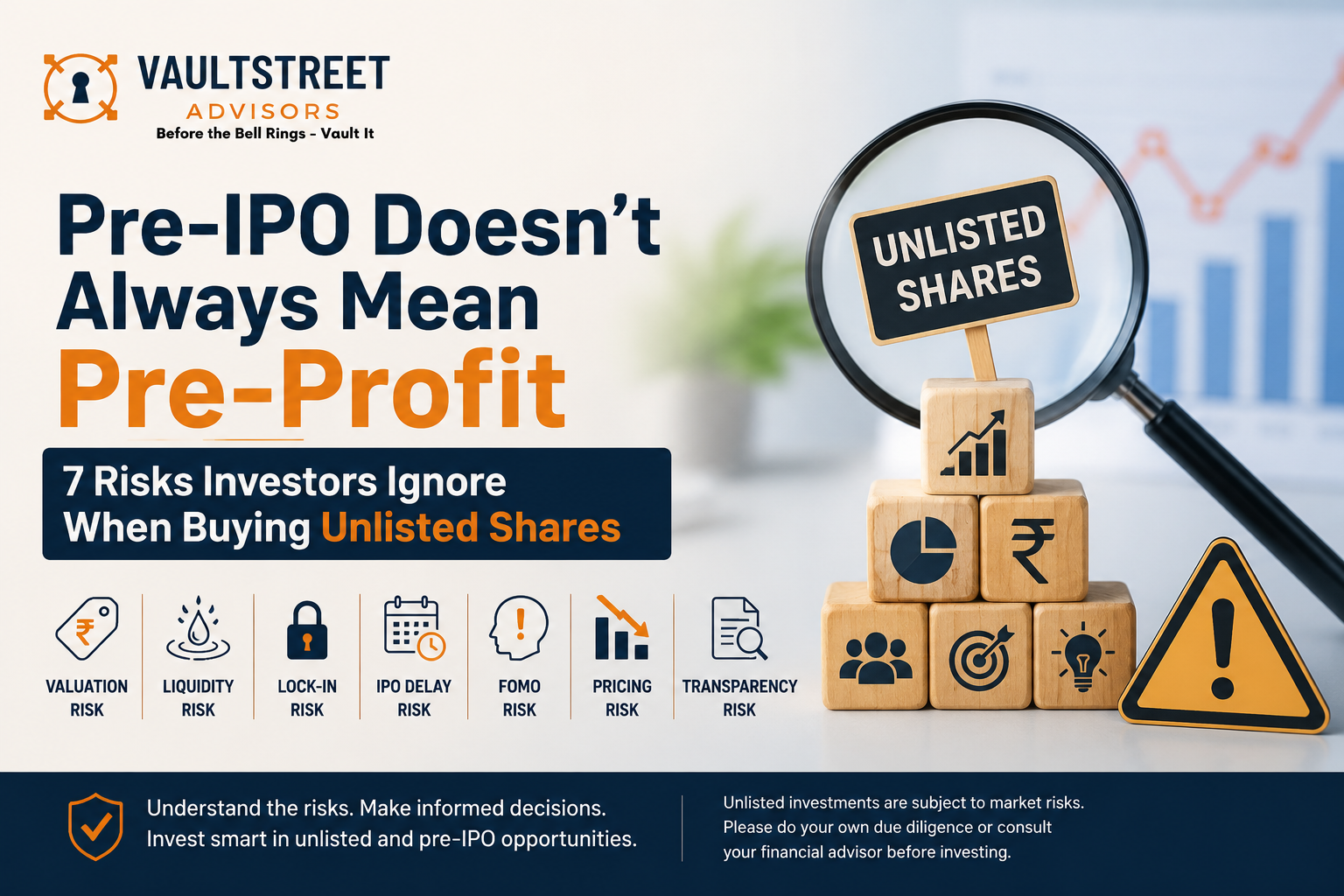
Before buying unlisted shares purely because an IPO may be approaching, here are 7 risks every investor should understand.
What Are Pre-IPO and Unlisted Shares?
An unlisted share is an equity share of a company that is not currently traded on a recognised stock exchange such as NSE or BSE.
A pre-IPO share generally refers to an unlisted share of a company that investors expect may eventually undertake an Initial Public Offering.
The two terms are often used interchangeably, but they are not exactly the same.
Every pre-IPO share is currently unlisted.
But not every unlisted company is necessarily preparing for an IPO.
Unlisted shares may be acquired through off-market transactions and other permitted routes. Unlike listed shares, however, they do not have a continuously traded exchange price.
That difference creates both opportunities and risks.
Why Are Investors Attracted to Pre-IPO Shares?
The basic investment thesis sounds compelling.
An investor identifies a potentially valuable company before it becomes publicly listed, acquires shares at an attractive valuation and participates in the company’s future growth.
If the company subsequently launches an IPO at a higher valuation, the early investor could potentially benefit.
There can also be opportunities to access businesses and sectors that are not yet available through listed markets.
But the phrase that matters most in that entire paragraph is:
“at an attractive valuation.”
Without valuation discipline, getting in early can mean very little.
Risk 1: The Unlisted Price May Already Include the IPO Excitement
One of the biggest misconceptions surrounding pre-IPO investing is:
“If I buy before the IPO, I must be getting it cheaper.”
That isn’t necessarily true.
As IPO expectations increase, demand for a company’s unlisted shares can rise rapidly.
Investors begin discussing the company.
News reports speculate about the IPO.
More buyers enter the unlisted market.
Available supply becomes limited.
Prices rise.
Eventually, the unlisted market may begin pricing in not only the company’s current value but also a substantial portion of its expected future IPO valuation.
At that stage, an investor may technically be buying before the IPO but paying a valuation that already assumes a very successful IPO.
The question therefore shouldn’t be:
“Can I buy this before the IPO?”
It should be:
“At what valuation am I buying this before the IPO?”
That is a very different question.
Risk 2: The IPO Price Can Be Lower Than the Unlisted Market Price
This is perhaps the most important lesson for pre-IPO investors.
There is no rule requiring an IPO to be priced above the price at which shares previously changed hands in the unlisted market.
A company and its investment bankers ultimately need to determine a public-market valuation capable of attracting IPO investors.
That valuation may be very different from the valuation created in a relatively less-liquid unlisted market.
NSDL: A Useful Case Study
The NSDL IPO provided a striking example.
Before its IPO, NSDL shares had reportedly traded in the unlisted market at approximately ₹1,025 per share.
The IPO price band was subsequently fixed at ₹760–₹800.
At the upper end, that represented roughly a 22% discount to the earlier cited unlisted-market price.
Think about what that means.
An investor applying in the IPO could potentially acquire the same underlying business at ₹800.
An investor who had entered the unlisted market at ₹1,025 had paid materially more simply for getting there earlier.
The company had not suddenly become bad.
The entry valuation was the problem.
HDB Financial Services: Another Important Reminder
HDB Financial Services demonstrated the same principle even more dramatically.
Its IPO was priced at ₹740 per share, compared with a reported unlisted-market price of around ₹1,225 before the issue.
That represented roughly a 40% discount.
Again, the important lesson isn’t whether HDB Financial was a good or bad company.
It is that:
A good company bought at an excessive pre-IPO valuation can still become a poor investment.
This is why investors should never treat the prevailing unlisted price as proof of fair value.
Risk 3: Liquidity Is Very Different From Listed Shares
When you buy a listed share on NSE or BSE, there is an organised marketplace connecting buyers and sellers.
For actively traded companies, investors can generally see:
- Bid prices
- Ask prices
- Trading volumes
- Market depth
- Last traded price
- Historical price movements
The unlisted market works differently.
There is no continuously operating public order book establishing a universally observable market price.
That creates liquidity risk.
You may find it relatively easy to purchase a popular unlisted share when demand is strong.
Selling it when you want to exit may be another matter.
A buyer may not be immediately available.
The price offered may be substantially below your expectation.
The bid-ask spread can also be significantly wider than in liquid listed securities.
Therefore:
Never confuse the ability to buy an unlisted share with the ability to sell it whenever you want.
Liquidity should be considered before investing, not when you suddenly need an exit.
Risk 4: The IPO Can Be Delayed — Sometimes for Years
Another common sales narrative is:
“IPO expected soon.”
But what exactly does “soon” mean?
Three months?
Six months?
One year?
Three years?
Companies can intend to list and still face delays because of:
- Regulatory observations
- Market conditions
- Internal restructuring
- Litigation
- Corporate governance matters
- Changes in business performance
- Promoter decisions
- Weak IPO markets
- Valuation disagreements
Even filing IPO documents does not guarantee that the listing will occur exactly when investors expect.
This creates an important test.
Ask yourself:
Would I still want to own this company if the IPO were delayed by two years?
If the entire investment thesis collapses without a quick IPO, you may not really be investing in the business.
You may simply be speculating on a liquidity event.
Risk 5: You May Not Be Able to Sell Immediately After Listing
Another misconception is:
“I’ll buy before the IPO and sell on listing day.”
That may not always be possible.
Applicable SEBI regulations can impose lock-in requirements on certain pre-IPO shareholdings following an IPO.
The precise treatment depends on the nature of the holding, shareholder category, acquisition circumstances and regulations applicable at the time of the issue.
That means investors should understand the applicable lock-in provisions before buying, rather than discovering them when the IPO approaches.
This is particularly important for investors whose entire strategy depends on immediately capturing a potential listing premium.
An expected listing gain is of limited practical value if your shares cannot be sold during the period when you expected to exit.
Risk 6: Price Discovery Is Less Transparent
Listed shares undergo continuous price discovery.
Thousands or millions of market participants can simultaneously express their views by buying or selling.
Unlisted shares do not have the same mechanism.
You may hear:
“Current market price is ₹500.”
But that immediately raises several questions.
Was a transaction actually completed at ₹500?
How many shares were involved?
Was it a retail-sized transaction or a large block?
What is the current buying price?
What is the current selling price?
How frequently are transactions taking place?
Has the company’s financial position changed since the quoted price was established?
Different intermediaries may quote different prices for the same unlisted security.
Therefore, investors should distinguish between:
Quoted price
and
fair valuation.
They are not necessarily the same thing.
Risk 7: FOMO Can Replace Fundamental Analysis
This may be the biggest risk of all.
The hottest pre-IPO opportunities usually share certain characteristics.
A famous brand.
An anticipated IPO.
Limited availability.
Rapidly rising unlisted prices.
Social-media discussion.
Stories about early investors making enormous returns.
Suddenly the fear is no longer:
“What if I lose money?”
It becomes:
“What if everybody makes money except me?”
That is FOMO.
And FOMO changes investor behaviour.
Instead of asking:
What is the company worth?
investors ask:
How quickly can I get shares?
Instead of asking:
What could go wrong?
they ask:
How much can it list at?
Instead of asking:
What return does this valuation require?
they ask:
How many shares can I get?
That is precisely when valuation discipline becomes most important.
Share Price Is Not Valuation
This deserves special attention because it is one of the most common mistakes in unlisted investing.
Suppose:
Company A: ₹500 per share
Company B: ₹2,000 per share
Which one is cheaper?
You cannot answer.
You need to know:
- Number of outstanding shares
- Market capitalisation
- Revenue
- Profit
- Earnings per share
- Book value
- Debt
- Growth
- Cash generation
- Comparable-company valuations
A ₹2,000 share could potentially be cheaper on valuation than a ₹500 share.
This is why sophisticated investors don’t simply ask:
“What is the NSE unlisted share price?”
or
“What is the XYZ pre-IPO share price?”
They should also ask:
“What market capitalisation does that price imply?”
That question provides much more information.
7 Questions to Ask Before Buying Any Pre-IPO Share
Before investing in an unlisted or pre-IPO company, consider asking:
1. What market capitalisation am I paying?
Convert the per-share price into an implied company valuation.
2. What are the company’s earnings?
Study revenue, profitability, cash flows and earnings growth.
3. What valuation multiple am I paying?
Compare P/E, price-to-book and other relevant metrics with suitable listed peers.
4. What happens if the IPO valuation is lower?
Calculate the downside instead of considering only the potential upside.
5. What happens if the IPO is delayed?
Make sure your investment thesis can survive a longer holding period.
6. How will I exit before the IPO?
Understand liquidity, available buyers and potential spreads.
7. Would I buy this company if there were no IPO announcement?
This may be the most powerful question of all.
If the answer is no, reconsider what exactly you are investing in.
Pre-IPO Investing: Opportunity vs Speculation
None of this means investors should avoid unlisted shares.
There can be genuine opportunities.
Investors may gain access to quality businesses before public listing.
They may participate in a company’s growth at an earlier stage.
And in certain situations, the valuation available in the unlisted market may be attractive relative to the company’s long-term prospects.
But the opportunity does not come simply from being early.
It comes from being early at the right valuation.
Consider the difference:
Investing
Strong Business + Sensible Valuation + Patience + Due Diligence
versus
Speculation
Famous Company + IPO Rumour + Rising Price + FOMO
Both involve buying before an IPO.
But they are completely different investment processes.
The VaultStreet View: Don’t Buy the IPO Story. Understand the Business.
At VaultStreet Advisors, we believe access to an unlisted opportunity should be the beginning of the investment evaluation — not the end.
Before investing, understand four things:
Business. Valuation. Liquidity. Risk.
An upcoming IPO may create an opportunity.
But it can also create excessive optimism.
And the NSDL and HDB Financial examples provide a valuable reminder:
Getting in before the IPO does not automatically mean getting in at the best price.
Ultimately, investors should not ask only:
“Will this company launch an IPO?”
They should ask:
“If it does, what valuation am I paying today compared with what the public market may reasonably pay tomorrow?”
That is the difference between chasing an IPO and evaluating an investment.
Final Thoughts
India’s unlisted and pre-IPO market is becoming increasingly accessible to individual investors.
That can create exciting opportunities.
But greater accessibility should also bring greater responsibility.
Before investing in an unlisted company:
Don’t buy because the IPO is coming.
Don’t buy because the price has already risen.
Don’t buy because somebody says shares are becoming scarce.
Study the company.
Understand the valuation.
Assess liquidity.
Know the lock-in implications.
Consider what happens if the IPO is delayed.
And above all:
Don’t confuse getting in early with getting in cheap.
In pre-IPO investing, those can be two very different things.
About VaultStreet Advisors
VaultStreet Advisors is a boutique platform focused on facilitating transactions in unlisted and pre-IPO shares.
Our objective is to help investors access opportunities in the unlisted market while encouraging greater awareness around business fundamentals, valuation, liquidity and transaction-related risks.
Before the bell rings… Vault it!
Disclaimer
This article is intended solely for educational and informational purposes and should not be construed as investment advice, research, solicitation or a recommendation to buy or sell any security.
VaultStreet Advisors facilitates transactions in unlisted and pre-IPO shares and does not provide investment advisory or portfolio management services.
Prices in the unlisted market may vary between transactions and intermediaries and can change significantly. Historical unlisted-market prices and IPO prices mentioned in this article are included only as educational examples and should not be interpreted as current prices or indicators of future performance.
Unlisted and pre-IPO investments involve risks including valuation risk, liquidity risk, regulatory risk, transfer restrictions, lock-in requirements, IPO delays or cancellations and potential loss of capital. Investors should conduct independent due diligence and consult an appropriate financial adviser before making investment decisions.