


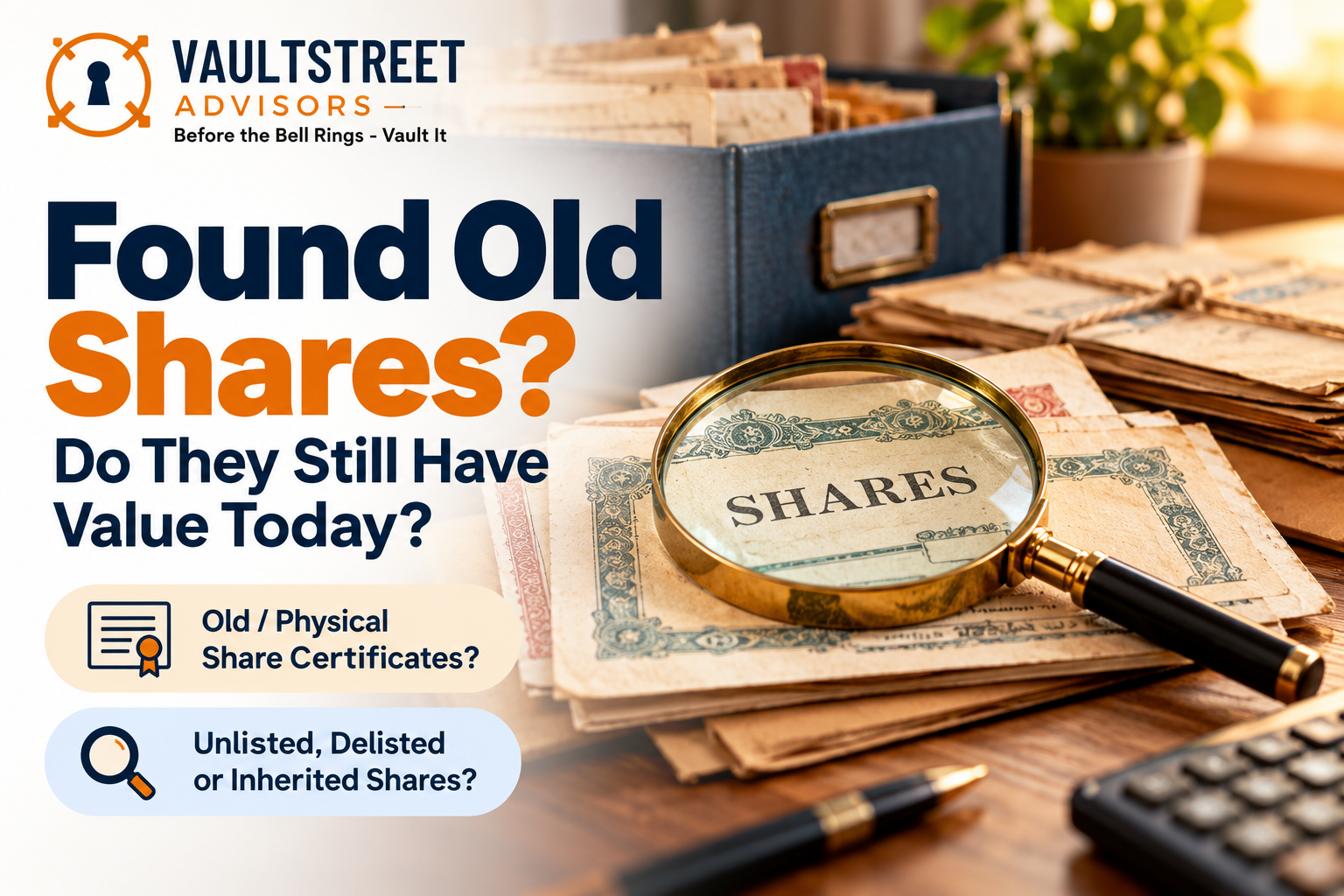
An old envelope is discovered while clearing a cupboard.
Inside are share certificates purchased by your father 25 years ago.
Or perhaps you inherited shares through a Will, but they are still recorded in the name of a deceased family member.
Maybe you own shares of a company that disappeared from the stock exchange years ago.
Or you have shares of an unlisted company and simply don’t know whether anyone buys them today.
The first instinct is often to ask:
“How much are these shares worth?”
But that may be the wrong first question.
Before trying to establish a price, you need to establish something more fundamental:
What exactly do you own today?
A company may have changed its name, merged with another business, undergone a corporate restructuring, been delisted, remained unlisted, entered liquidation or ceased to exist.
And even where the company still exists, three separate questions need to be answered:
Does the security still exist?
Do you have clear ownership/title to it?
Is there a market in which somebody is actually willing to buy it?
At VaultStreet Advisors, we believe this distinction is particularly important when dealing with old, unlisted, delisted or otherwise illiquid securities.
This guide explains how investors can begin investigating such holdings in India.
Found an Old Share Certificate? Don’t Assume It Is Worthless
A physical share certificate can look like an outdated piece of paper.
That does not, by itself, tell you whether the underlying economic interest has disappeared.
The company might still exist.
It may have changed its name.
It may have merged or undergone another corporate action.
Its shares may have been listed earlier but subsequently delisted.
Or the company may still be unlisted and its shares could potentially have an off-market market, subject to ownership, transferability, availability and applicable restrictions.
Conversely, an impressive-looking certificate does not prove that the shares have significant current value.
The company may have failed, entered liquidation, undergone restructuring or have practically no liquidity.
So avoid both extremes:
Old certificate ≠ automatically valuable.
But equally:
Old certificate ≠ automatically worthless.
Research comes first.
Step 1: Identify Exactly What You Have
Start with the certificate and any accompanying records.
Look for information such as:
- exact company name;
- shareholder name(s);
- folio number;
- certificate number;
- distinctive numbers;
- number of shares;
- face value;
- date of issue; and
- any correspondence received from the company or its Registrar and Transfer Agent (RTA).
Do not focus only on the company name printed prominently on the certificate.
A company incorporated decades ago may not operate under the same name today.
Corporate identity can change even when the underlying corporate entity continues.
That makes identification more important than simply searching:
“XYZ company old share price.”
Step 2: Find Out What Happened to the Company
Once the original company has been identified, investigate its corporate history.
Broadly, an old holding could relate to a company that is:
1. Still listed
The company continues to trade on a recognised stock exchange, although your particular holding may remain in physical form or require other action.
2. Unlisted
The company exists, but its equity shares are not traded on a recognised stock exchange.
This is an important distinction.
An unlisted share is not necessarily a worthless share.
It simply means that investors do not have the normal NSE/BSE-style exchange order book and continuous price discovery available for a listed share.
If you’re unfamiliar with this market, VaultStreet Advisors’ guide to unlisted share market terminology including ISIN, off-market transfers, liquidity and valuation provides useful background.
3. Delisted
A company that was previously listed may subsequently have been delisted.
Delisting and extinction are not the same thing.
The absence of an exchange quotation does not by itself establish that the company has ceased to exist.
VaultStreet Advisors has previously examined the important distinction between ownership and exchange valuation in our article on delisted stocks and demat-account valuation.
4. Renamed
The company may exist under another name.
This is one reason searching only the old company name can produce incomplete or confusing results.
5. Merged, amalgamated or restructured
The original shares may have been affected by a merger, amalgamation, demerger, share swap or another corporate action.
The relevant question then becomes:
What entitlement, if any, resulted from the corporate action?
6. Under liquidation, struck off or otherwise inactive
In some cases, there may be little or no economic value remaining for equity shareholders.
But that conclusion should come from investigating the company’s actual status rather than assuming it from the age of the certificate.
Step 3: Understand the Difference Between Ownership and Value
This may be the single most important lesson in this guide.
Suppose you discover 1,000 shares of an old company.
There are actually two separate investigations.
Question A: Who legally owns the shares?
This can involve issues such as:
- registered shareholder;
- surviving joint holder;
- nominee;
- legal heir;
- Will or succession;
- transmission;
- old transfer documents; and
- whether the shares were ever properly transferred.
Question B: What are the shares worth today?
This involves a different set of questions:
- Does the company still exist?
- What security do the certificates represent today?
- Is the company listed, unlisted or delisted?
- Is there a current market?
- Are buyers actually available?
- What quantity is marketable?
- What are recent indicative transaction levels, if any?
- Are there restrictions affecting transfer?
- How liquid is the security?
Ownership and market value are not the same problem.
You could establish ownership of shares for which there is practically no market.
Equally, you could identify an economically valuable security but still have to complete transmission or other ownership formalities before being able to deal with it.
Step 4: If the Shares Are Physical, Understand the Current Rules
India’s securities market has moved decisively towards dematerialisation.
SEBI clarified that, from 1 April 2019, transfers of securities held in physical form generally cannot be processed unless the securities are first held in dematerialised form.
Importantly, this did not mean investors were prohibited from continuing to hold physical securities.
It also did not make an old physical certificate automatically invalid.
The restriction concerned the manner in which transfers could be processed.
There are separate rules for situations such as transmission and transposition.
Investors dealing with old physical certificates should therefore avoid assuming that an old-fashioned transfer deed can simply be submitted today in the same way it might have been decades ago.
Important 2026 Update: SEBI’s Special Window for Certain Old Physical Share Transfers
This is particularly relevant in 2026.
SEBI announced a Special Window for Transfer and Dematerialisation of Physical Securities for certain investors who could not complete old transfers before the physical-transfer regime changed.
The window runs from:
5 February 2026 to 4 February 2027.
According to SEBI, the window covers eligible cases where the transfer deed had been executed before 1 April 2019, including certain fresh lodgements and cases that had previously been rejected, returned or not attended to because of deficiencies.
The original security certificate must be available, among other applicable conditions.
This is not a blanket reopening of physical-share transfers.
Eligibility depends upon the facts and documentation of the particular case.
Therefore, anyone possessing old certificates together with historical transfer documentation should check the current SEBI requirements and approach the relevant issuer/RTA rather than assuming the case is permanently closed.
Step 5: What If the Shares Belonged to Someone Who Has Died?
This situation is extremely common.
A family may discover certificates registered in the name of a parent, grandparent or another deceased relative.
This is generally a transmission issue rather than an ordinary sale/transfer.
SEBI defines transmission as the process through which securities of a deceased holder are transmitted to the surviving joint holder(s), nominee or legal heir(s), as applicable.
For physical securities, the claimant generally has to correspond with the relevant issuer company/RTA.
Under SEBI’s current framework, securities arising from transmission are issued in demat mode.
The precise documentation can depend upon factors including:
- whether the holding was single or joint;
- whether a nominee exists;
- who the legal heirs are;
- the value of the securities;
- whether a Will exists;
- whether probate, succession certificate or other documentation is applicable; and
- the particular facts of the estate.
Do not confuse transmission with valuation.
Completing a transmission establishes the claimant’s entitlement to the securities.
It does not tell you what those securities are worth.
That requires a separate market and company-status investigation.
Step 6: What If You Bought Physical Shares Years Ago but Never Transferred Them?
This is another surprisingly important category.
Imagine that someone purchased physical shares many years ago.
The buyer paid the seller and received the certificates—but never completed registration of the transfer.
The certificates may therefore physically be with the buyer while the company’s records continue to show somebody else as the registered shareholder.
SEBI’s current investor FAQ specifically addresses this situation.
The issue cannot simply be solved by treating possession of the certificate as equivalent to a properly registered holding.
Depending upon the facts, whether the transferor is traceable and the available documentation, additional steps may be necessary.
And for certain eligible historical cases, the 2026–27 Special Window described above may be relevant.
This is precisely why old share certificates should be investigated individually rather than valued merely from the name printed on the paper.
Step 7: Check Whether the Shares Have Moved to IEPF
Another possibility is the Investor Education and Protection Fund (IEPF).
Depending on the history of the holding and applicable statutory conditions, shares and/or unpaid amounts may have been transferred to the IEPF.
If that has happened, the process is different from simply approaching a buyer for the shares.
The IEPF Authority provides Form IEPF-5 for eligible claims relating to unpaid amounts and shares transferred to the Fund.
The IEPF’s current instructions also allow an application to be made by the legal representative of a deceased person, subject to the applicable requirements.
So if an old shareholding appears to have “disappeared”, don’t immediately conclude that the investment has vanished economically.
Investigate whether the holding has been affected by IEPF provisions.
Step 8: If the Company Is Unlisted, Does a Market Exist?
Now we reach the area most relevant to VaultStreet Advisors.
Suppose your investigation establishes that:
- the company still exists;
- the shares still exist;
- ownership can be established; and
- the company is unlisted.
The next question is:
Is there actually a market for the shares?
Unlike listed securities, unlisted shares generally do not have a continuously visible NSE/BSE-style order book.
Prices may be negotiated privately and can vary according to:
- company;
- security class;
- ISIN;
- quantity;
- availability;
- buyer demand;
- seller supply;
- transaction size;
- liquidity; and
- prevailing market conditions.
This is why an online quotation should not automatically be interpreted as the price at which your entire holding can definitely be sold.
VaultStreet Advisors explains this distinction in greater detail in our guide to unlisted share prices, bids, offers, spreads and liquidity.
“Price” and “Value” Are Not the Same Thing
Suppose somebody quotes:
₹500 per share
for an unlisted company.
That does not automatically establish that your shares are “worth ₹500 each”.
You still need to understand:
- what security is being quoted;
- whether your security is identical;
- the applicable ISIN;
- whether the quote is a bid, offer or indicative price;
- the quantity associated with that price;
- whether an actual buyer exists;
- whether your holding can be transferred;
- the company’s underlying valuation; and
- the liquidity available.
This distinction becomes even more important in private markets.
As VaultStreet Advisors demonstrated in our analysis of unlisted prices versus eventual IPO prices, an unlisted-market quotation, an eventual IPO price and a subsequent listed-market price can all be different.
A quoted price is information.
It is not a guaranteed exit value.
Step 9: Check the Exact Security — Not Just the Company
This is especially important for unlisted companies.
Two people may both say:
“I own shares of XYZ Ltd.”
But they may not necessarily own economically identical securities.
Depending upon the company, there could be:
- ordinary equity shares;
- preference shares;
- compulsorily convertible preference shares (CCPS);
- partly paid securities;
- securities with different rights; or
- securities affected by subsequent corporate actions.
The ISIN, where applicable, can help identify the security.
This is also why investors should be cautious about comparing a historical certificate directly with a current online “share price” without first establishing exactly what the old holding represents today.
Step 10: Don’t Forget Corporate Actions
Twenty years is a long time in corporate history.
A shareholder’s original 100 shares could potentially have been affected by events such as:
- bonus issues;
- stock splits or consolidations;
- mergers;
- demergers;
- amalgamations;
- schemes of arrangement;
- rights issues;
- buybacks;
- name changes; or
- other capital restructurings.
Not every corporate action automatically creates an entitlement for every historical holder; the applicable record dates, terms and ownership position matter.
The important principle is simpler:
Never value an old certificate solely by multiplying the number printed on it by today’s apparent share price.
First reconstruct what happened to the holding.
A Practical 7-Step Checklist for Old Shares
If you have discovered old, physical, inherited, unlisted or delisted shares, work through the problem in this order:
1. Identify the original security
Record the company name, shareholder, folio, certificate number, distinctive numbers and number of shares.
2. Establish the company’s current status
Is it listed, unlisted, delisted, renamed, merged, liquidated or otherwise restructured?
3. Trace relevant corporate actions
Look for mergers, splits, bonuses, name changes and other events affecting the holding.
4. Establish whether the security still exists
Do not assume that the old certificate maps one-for-one to a security currently available in the market.
5. Establish ownership
If the registered shareholder has died, transmission may need to be completed. If an old purchase was never registered, investigate the appropriate process.
6. Determine the demat/IEPF/RTA position
Find out whether the shares can or must be dematerialised, whether the RTA needs to be approached and whether IEPF is involved.
7. Only then investigate current value and liquidity
If the resulting security is unlisted or otherwise off-market, determine whether a genuine market exists and what current indicative buying/selling levels may be.
That order matters.
Can VaultStreet Advisors Tell You What an Old Share Is Worth?
VaultStreet Advisors focuses on India’s unlisted and pre-IPO share market.
If your investigation establishes that you hold shares in an existing unlisted company, the relevant question may become whether there is a current off-market market for that security and what indicative price/availability exists.
You can view selected securities on the VaultStreet Advisors Unlisted Shares page or contact VaultStreet Advisors.
However, VaultStreet Advisors is not an RTA, legal adviser, succession adviser or IEPF claim agent.
Where the issue involves title, succession, probate, legal-heir disputes, transmission, missing documentation or statutory claims, investors should approach the relevant issuer/RTA and obtain appropriate professional advice where required.
That separation matters:
First establish what you legally own.
Then establish what the security actually is.
Then investigate whether it has a market and value.
What About Listed Shares and Demat/Trading Services?
Where the holding relates to listed-market securities, demat/trading requirements or regular market participation, investors can separately explore the services offered by Riddhi Siddhi Share Brokers.
Riddhi Siddhi Share Brokers provides assisted trading and other capital-market services as an NSE & BSE registered Authorised Person of a leading broker.
This keeps the roles distinct:
VaultStreet Advisors: unlisted/pre-IPO market information, opportunities and indicative off-market pricing.
Riddhi Siddhi Share Brokers: listed-market broking-related and assisted-trading services.
The VaultStreet Advisors View
An old share certificate creates curiosity because everybody wants to know:
“What is it worth?”
But the better investigation starts several steps earlier.
What company does this certificate represent today?
Does that company still exist?
Has it changed its name or structure?
Is the security listed, unlisted or delisted?
Did mergers, splits or other corporate actions change the holding?
Who legally owns it today?
Can it be dematerialised or transmitted?
Is there actually a buyer?
Only after answering those questions does a price become meaningful.
That dusty certificate in the cupboard may ultimately have little economic value.
It may represent a security that still exists.
Or it may lead you through decades of corporate history before you can even determine what you own.
The key is not to guess.
Identify → Verify → Establish Ownership → Trace Corporate Actions → Check Market Status → Investigate Value.
That is the sensible order.
Frequently Asked Questions
Are old physical share certificates still valid in India?
Simply being in physical form does not automatically make a share certificate invalid. SEBI clarified that investors were not prohibited from holding physical securities after 1 April 2019. However, the rules governing transfer, dematerialisation, transmission and other servicing need to be followed.
Can physical shares still be transferred in India?
Ordinary transfers of listed securities in physical form have generally not been processed since 1 April 2019; transfer ordinarily requires dematerialisation. However, transmission and certain other situations are treated differently. SEBI has also opened a specific Special Window from 5 February 2026 to 4 February 2027 for eligible historical transfer cases meeting its conditions.
What is SEBI’s 2026 special window for old physical shares?
It is a temporary facility for certain old physical-security transfer cases where the transfer deed was executed before 1 April 2019. The window runs from 5 February 2026 to 4 February 2027. Eligibility conditions apply, including availability of the original security certificate.
What happens to shares after the shareholder dies?
The process is known as transmission. Depending on the holding structure and circumstances, securities may be transmitted to surviving joint holders, nominees or legal heirs. For physical securities, the claimant generally deals with the issuer/RTA, and under the current SEBI framework securities resulting from transmission are issued in demat mode.
I found shares registered in my father’s or grandfather’s name. Can I sell them?
Do not assume so. The ownership/transmission position generally needs to be resolved first. The required procedure depends on the holding, nomination, legal-heir position and other facts.
What if the company has changed its name?
Trace the company’s corporate history and confirm whether the old company and current entity are legally connected. A name change alone does not necessarily extinguish a shareholder’s interest.
Are delisted shares worthless?
Not necessarily. Delisting means the shares are no longer traded on the relevant recognised exchange. It does not automatically mean the company has ceased to exist or that its equity has zero economic value. However, liquidity and price discovery can be extremely limited.
Can unlisted shares have a market price?
They can have negotiated off-market prices, but there is generally no continuously visible exchange order book comparable to NSE or BSE. Quotes can vary by quantity, counterparty, availability, liquidity and time.
Can VaultStreet Advisors buy or value every old share certificate?
No. Every case is different. VaultStreet Advisors’ relevant area is the unlisted/pre-IPO market and indicative market information for selected securities. Legal ownership, succession, transmission, IEPF claims and RTA processes may require the issuer/RTA or appropriate professional assistance.
How do I know whether my old shares went to IEPF?
Check the relevant company records and IEPF resources. Where shares or unpaid amounts have been transferred to IEPF and the claimant is eligible, the IEPF Authority provides the Form IEPF-5 claim process.
Have an Unlisted or Pre-IPO Holding You Want to Understand?
Explore VaultStreet Advisors for information on India’s unlisted and pre-IPO market, or contact us for current indicative availability and market information on selected unlisted securities.
Message +91 99875 53455 to request access to our exclusive WhatsApp community for daily prices, opportunities and market updates.
For investors interested in listed-market execution, connect with Riddhi Siddhi Share Brokers for Assisted Trading Services.
Disclaimer
This article is for educational and informational purposes only and should not be construed as legal, tax, succession, investment or financial advice, or as a recommendation or solicitation to buy, sell or hold any security.
VaultStreet Advisors is a boutique distributor in the unlisted and pre-IPO space and is not a SEBI-registered investment adviser. Unlisted and pre-IPO shares involve significant risks including liquidity risk, valuation risk, counterparty risk and regulatory uncertainty. Indicative prices and availability, where provided, can change and do not guarantee an exit or transaction at any stated price.
Procedures involving physical securities, transmission, succession, legal heirs, Wills, probate, IEPF, RTAs and dematerialisation depend on the facts of each case and applicable rules. Investors should verify current requirements with the relevant company/RTA, depository participant, SEBI/IEPF or an appropriately qualified professional before acting.
Investments are subject to market and other risks. Past performance is not indicative of future results. Conduct your own due diligence before making any investment decision.