


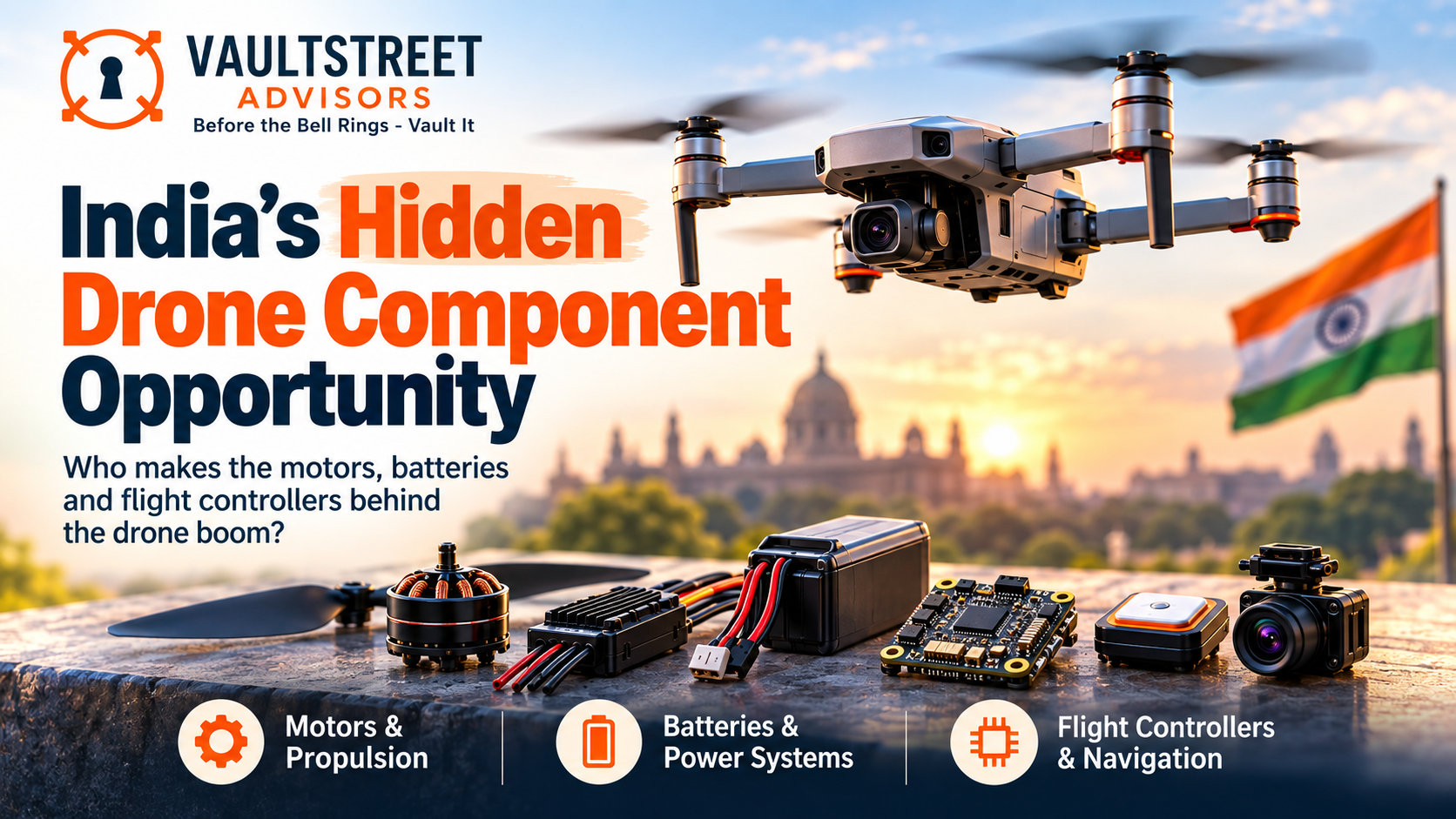
When investors think about India’s drone industry, the first names that usually come to mind are companies that manufacture complete drones.
But perhaps the more interesting story is hiding inside the drone.
Who makes the motor?
Who manufactures the Electronic Speed Controller (ESC)?
Where does the flight controller come from?
Who supplies the battery, navigation system, communication equipment, cameras, sensors and composite airframe?
And most importantly:
How much of an Indian drone is actually made in India?
That question could become increasingly important as India attempts to move from assembling drones towards building a genuinely indigenous drone and UAV supply chain.
India’s drone ecosystem now includes complete drone manufacturers as well as specialised businesses working on propulsion, electronics, navigation, batteries, sensors, avionics, composites and autonomous systems.
Some of these companies are listed.
Many remain private or unlisted.
And a few private drone-component businesses have already been acquired by listed defence companies.
For investors following India’s defence, aerospace and unlisted markets, this creates an entirely different way of looking at the drone story.
Instead of asking only:
“Who manufactures drones in India?”
It may be worth asking:
“Who manufactures what goes inside those drones?”
First, Let’s Open Up a Drone
A modern drone is far more sophisticated than a frame with four propellers.
Depending upon its application, a UAV may contain dozens or even hundreds of components and sub-components.
At a simplified level, the important systems include:
Airframe & Composite Structure
The skeleton of the aircraft.
Weight matters enormously in aviation. Carbon fibre and advanced composites can help reduce weight while maintaining structural strength, potentially improving range, endurance and payload capacity.
Motors & Propulsion
Electric drones generally use high-performance brushless motors.
The propulsion system influences thrust, efficiency, payload capacity and endurance.
Larger UAVs can use substantially more sophisticated propulsion systems.
Electronic Speed Controllers — ESCs
An ESC precisely controls the amount of power delivered to each motor.
Without accurate motor control, stable flight becomes impossible.
Propellers
Propeller design affects thrust, efficiency, vibration, noise and flight characteristics.
Batteries & Power Management
Battery capacity and energy density directly affect how long an electric drone can remain airborne.
For commercial and defence applications, endurance remains one of the industry’s biggest engineering challenges.
Flight Controller
This is effectively the drone’s brain.
The flight controller receives information from sensors and continuously adjusts the aircraft’s motors and control systems to maintain stability, altitude, direction and autonomous flight.
Navigation
GPS, India’s NavIC, GNSS, inertial navigation and increasingly sophisticated navigation technologies tell the aircraft where it is and where it needs to go.
For military applications, the ability to operate when satellite navigation is disrupted or unavailable becomes particularly important.
Communications
Radio-frequency systems, telemetry and command-and-control equipment connect the drone with its operator or wider network.
Cameras, Sensors & Payloads
Depending on the application, drones may carry:
- EO/IR cameras
- thermal imaging systems
- LiDAR
- multispectral sensors
- hyperspectral sensors
- surveillance equipment
- agricultural spraying systems
- mapping equipment
- specialised defence payloads
Suddenly, the drone industry starts looking much bigger than simply manufacturing drones.
It becomes an entire manufacturing ecosystem.
India’s Next Drone Challenge: Components
India has spent the last several years encouraging domestic drone manufacturing.
Government policy restricted the import of complete drones while continuing to permit the import of drone components.
That helped create an environment in which Indian companies could assemble and manufacture UAV platforms domestically.
But it also highlights the industry’s next challenge.
A drone assembled in India does not necessarily mean that every important component inside that drone was manufactured in India.
Specialised motors, semiconductors, sensors, electronic components, battery cells, navigation equipment and other technologies may still involve imported components or technology.
Therefore, India’s next stage of drone indigenisation could be much harder than the first.
Moving from “Made in India drones” to “Made in India drone technology.”
That distinction matters.
The Government Has Already Identified Drone Components as a Separate Industry
India’s drone Production Linked Incentive framework did not concentrate solely on companies manufacturing complete drones.
It separately recognised drone-component manufacturers.
Eligible areas included technologies such as:
- airframes;
- propulsion systems;
- power systems;
- batteries;
- inertial navigation;
- flight-control modules;
- communication systems;
- cameras;
- sensors;
- payloads;
- detect-and-avoid systems; and
- emergency systems.
The original PLI beneficiary universe included component-focused companies such as Absolute Composites, Adroitec Information Systems, Alpha Design Technologies, Dynamake Engineering, Imaginarium Rapid, SASMOS HET Technologies, Servocontrols Aerospace India, Valdel Advanced Technologies, ZMotion Autonomous Systems and Zuppa Geo Navigation Technologies.
Several of these businesses remain privately held.
And since the original PLI programme was announced, another generation of specialised Indian component manufacturers has emerged.
Let’s look at some of them.
Vector Technics: The Propulsion System Inside the Drone
Vector Technics is one of the more interesting examples of how India’s drone-component industry is evolving.
The company works on technologies including:
- BLDC motors;
- Electronic Speed Controllers;
- propellers;
- starter generators;
- power-distribution systems; and
- UAV propulsion solutions.
But there is another interesting aspect to the story.
Vector Technics is no longer simply an independent private company.
Listed defence technology company Zen Technologies acquired a controlling 51% stake in Vector Technics in 2025.
That means a listed company now has direct exposure to an Indian manufacturer of motors, ESCs, propellers and other UAV propulsion components.
Vector subsequently expanded its manufacturing capabilities, with capacity reportedly reaching approximately 300,000 propulsion units annually.
This is worth understanding because it demonstrates a trend that could become increasingly important:
Listed defence companies can acquire specialised private technology companies rather than developing every capability internally.
For investors researching the sector, acquisitions like these can gradually change what a listed defence company actually does.
Reflex Drive: Building Drone Power Electronics in India
Another specialist company is Reflex Drive.
The company operates in drone electronics and propulsion, with products covering areas such as:
- drone motors;
- propulsion systems;
- ESCs;
- flight controllers;
- power-distribution boards; and
- associated power electronics.
Companies like Reflex Drive are important because they illustrate how India’s drone ecosystem is beginning to move beyond complete UAV manufacturing.
A drone OEM does not necessarily need to manufacture every component itself.
If specialised domestic suppliers emerge at sufficient scale and quality, the industry can develop something resembling the automotive supply chain:
OEMs at the top and specialised component manufacturers underneath them.
That could potentially make India’s drone manufacturing ecosystem much deeper.
Agam Robotics: The Flight Controller Story
The flight controller is one of the most critical pieces of electronics inside a drone.
Bengaluru-based Agam Robotics develops products including:
- flight controllers;
- GNSS modules;
- RTK systems;
- optical-flow and ranging sensors;
- power modules; and
- power-distribution boards.
There is also a valuable lesson hidden in the company’s localisation story.
A flight controller can be designed, assembled and manufactured in India while still using imported integrated circuits and semiconductors.
This distinction matters enormously.
“Manufactured in India” and “every component originates in India” are not the same thing.
The same issue exists across electronics manufacturing globally.
As India’s drone ecosystem develops, investors will need to distinguish between:
- Indian assembly;
- Indian manufacturing;
- Indian product design;
- Indian intellectual property; and
- completely indigenous underlying components.
These are very different levels of localisation.
Elena Geo Systems: Navigation May Become Critical
A drone needs to know where it is.
For consumer applications that might appear straightforward.
For defence applications, it isn’t.
GPS and other satellite navigation systems can potentially be jammed, spoofed or unavailable.
That makes indigenous navigation technology strategically important.
Bengaluru-based Elena Geo Systems specialises in NavIC-based Multi-GNSS technologies.
India’s own NavIC satellite navigation ecosystem could become increasingly important as autonomous platforms expand across drones, defence, vehicles and other applications.
Navigation may therefore represent one of the less visible but strategically important parts of the UAV supply chain.
Magnipower Technology: Solving the Battery Problem
Battery technology remains one of the fundamental constraints facing electric drones.
Every additional minute of flight endurance matters.
But simply adding a larger battery increases weight, which itself consumes more energy.
This engineering trade-off makes battery chemistry, battery-management systems and energy density extremely important.
Magnipower Technology is among the Indian companies working on lithium-ion batteries for drones.
But here again, localisation needs to be interpreted carefully.
A battery pack manufactured in India does not necessarily mean every underlying cell, material and electronic component is domestically manufactured.
That leads us to an even deeper layer of the drone ecosystem.
The Semiconductor Question
Take apart the flight controller again.
Inside it, you may find:
- microcontrollers;
- processors;
- inertial sensors;
- memory;
- RF chips;
- power-management ICs; and
- other specialised semiconductors.
India could therefore manufacture a PCB domestically, develop the software locally, assemble the electronics in India and still depend upon imported chips.
The deeper India’s drone localisation ambitions become, the more they eventually intersect with India’s semiconductor ambitions.
That doesn’t diminish domestic drone manufacturing.
It simply tells us that indigenisation has multiple layers.
When analysing any drone company, investors should therefore ask:
What is designed in India?
What is manufactured in India?
What is merely assembled in India?
Which critical inputs remain imported?
And who actually owns the intellectual property?
Those questions may ultimately be more revealing than simply asking whether a product carries a “Made in India” label.
Zuppa Geo Navigation: Indigenous Autopilot Technology
Chennai-based Zuppa Geo Navigation Technologies is another interesting private company in the ecosystem.
It was included among India’s original PLI component beneficiaries and has developed proprietary autopilot technology.
Autopilot systems are particularly interesting because they combine hardware, software, navigation and control systems.
That can potentially create a deeper technological moat than basic drone assembly.
As drones become increasingly autonomous, the intelligence controlling the aircraft may become just as important as the aircraft itself.
SASMOS: Even Wiring Matters
Not every important drone component sounds futuristic.
Consider wiring.
Modern aerospace platforms contain complex electrical systems that require specialised wiring harnesses, connectors and interconnection systems.
SASMOS develops electrical wiring interconnection systems, electromechanical systems, electronic control systems and fibre-optic interconnectivity products.
Its aerospace work has included wiring solutions for UAV platforms.
This illustrates how wide the drone supply chain can eventually become.
The businesses benefiting from increased UAV production need not all have the word “drone” in their names.
Servocontrols Aerospace: Actuation & Avionics
Servocontrols Aerospace India develops aerospace actuation, avionics and precision systems.
Actuation becomes particularly relevant in larger fixed-wing UAVs, where control surfaces need to move accurately and reliably.
This takes the drone-component story beyond the familiar quadcopter.
India’s UAV ecosystem increasingly includes:
- small surveillance drones;
- agricultural drones;
- mapping drones;
- tactical UAVs;
- fixed-wing aircraft;
- heavy-lift drones;
- loitering systems; and
- other autonomous platforms.
Different aircraft require very different component ecosystems.
Absolute Composites & Valdel: Making Drones Lighter
Weight is one of aviation’s oldest engineering challenges.
Reducing structural weight while maintaining strength can improve range, payload capacity and endurance.
That makes advanced composites and carbon-fibre structures particularly important.
Companies such as Absolute Composites and Valdel Advanced Technologies participate in advanced composite manufacturing for aerospace and defence applications.
Once again, these are companies that might never appear in a simple internet search for “drone companies in India.”
Yet they represent another layer of the supply chain.
Where Do Listed Companies Fit Into India’s Drone Story?
The listed universe needs to be approached carefully.
A company should not automatically be labelled a “drone stock” simply because drones represent one part of its business.
Some listed businesses manufacture complete drones.
Some supply components.
Some manufacture sensors.
Some provide defence electronics.
Some manufacture counter-drone systems.
Others own stakes in private drone companies.
Those are fundamentally different exposures.
Here are some examples.
Zen Technologies: Private Component Exposure Through Vector
Zen Technologies is widely associated with defence training and anti-drone technologies.
But the acquisition of Vector Technics added another dimension.
Through Vector, Zen now has exposure to UAV propulsion technologies including:
- motors;
- ESCs;
- propellers; and
- power systems.
That makes Zen an interesting example of a listed defence company moving deeper into the drone-component supply chain.
ideaForge: More Than Drone Assembly
Listed ideaForge Technology is primarily known as a UAV manufacturer.
However, its localisation efforts extend into areas such as:
- autopilot technology;
- payload systems;
- motors;
- communications;
- navigation algorithms; and
- software.
That means ideaForge occupies multiple levels of the drone value chain rather than merely assembling aircraft.
This distinction is important when comparing it with companies whose primary role is supplying components to other OEMs.
Paras Defence: Cameras, Sensors & Optics
For surveillance drones, the payload can sometimes be almost as important as the aircraft carrying it.
Listed Paras Defence & Space Technologies operates across sophisticated defence technologies including:
- electro-optical systems;
- infrared technologies;
- hyperspectral imaging;
- sensing electronics;
- avionics; and
- image processing.
These technologies can have applications across UAV and defence platforms.
Paras therefore represents a very different type of drone exposure from a company manufacturing motors or complete UAVs.
Bharat Electronics: Defence Electronics Rather Than a Pure Drone Company
Bharat Electronics Limited (BEL) operates across a huge defence-electronics universe.
Its capabilities extend across areas including:
- electro-optics;
- communications;
- navigation;
- radar;
- electronic warfare;
- UAV-related systems; and
- counter-UAS technologies.
It should therefore be understood as a diversified defence-electronics company with UAV exposure rather than a pure drone-component company.
That distinction becomes important when investors attempt to compare valuations across the sector.
Listed Parents Can Also Own Private Drone Businesses
Another category is emerging.
Large listed companies can own controlling interests in private drone manufacturers.
Examples include:
Coromandel International → Dhaksha Unmanned Systems
Dhaksha manufactures drones for applications including agriculture, defence and enterprise use.
The business sits within listed Coromandel International.
Reliance Industries → Asteria Aerospace
Asteria Aerospace operates in the drone and UAV ecosystem and sits within the wider Reliance Industries group structure.
RattanIndia Enterprises → Throttle Aerospace Systems
Throttle Aerospace operates across UAV applications including surveillance, mapping, agriculture, inspection and other areas through the wider RattanIndia ecosystem.
This again demonstrates why analysing India’s drone industry purely through company names can be misleading.
Sometimes the relevant drone business is sitting several layers below a much larger listed parent.
And Then There Is India’s Private Drone OEM Universe
Beyond listed companies and component manufacturers lies a growing universe of private drone manufacturers.
These include names such as:
- Raphe mPhibr;
- Garuda Aerospace;
- EndureAir;
- Aereo;
- Sagar Defence;
- IoTechWorld;
- Omnipresent Robot Technologies; and
- several others.
These businesses operate across different segments including defence, agriculture, surveillance, mapping, logistics and industrial applications.
Why do these private OEMs matter to the component story?
Because if Indian drone manufacturers scale production, they create domestic demand for:
motors + ESCs + batteries + flight controllers + sensors + navigation + composites + communications + replacement components.
The OEM and component ecosystems therefore reinforce one another.
An Unlisted Drone Company Already Available on VaultStreet: Gamma Rotors
For investors following India’s unlisted market, one company particularly relevant to this discussion is Gamma Rotors Limited.
Gamma Rotors operates within India’s defence and aerospace ecosystem and is engaged in the development, manufacturing, assembly and servicing of UAVs, drones and associated systems.
The company’s recent financial performance also shows how rapidly a relatively small UAV business can change.
Revenue increased from approximately ₹12.2 crore in FY25 to ₹28.8 crore in FY26.
Profit after tax increased from approximately ₹1.5 crore to ₹3.4 crore over the same period.
However, Gamma Rotors should not be confused with specialised component companies such as Vector Technics or Agam Robotics.
It represents exposure to the broader UAV manufacturing ecosystem rather than being a pure-play motor, battery or flight-controller manufacturer.
Readers interested in the company can explore its business profile, latest financial information, valuation metrics and indicative unlisted share price on the Gamma Rotors Unlisted Share Price page on VaultStreet Advisors:
For a wider perspective on how sectors such as defence, aerospace, advanced manufacturing and other emerging themes could shape the next phase of India’s private market, also read:
After NSE IPO: What Happens to India’s Unlisted Share Market?
India’s Drone Supply Chain at a Glance
| Drone Layer | Examples of Indian Companies |
|---|---|
| Composite structures | Absolute Composites, Valdel |
| Motors / Propulsion | Vector Technics, Reflex Drive, Nautical Wings |
| ESC / Power Electronics | Vector Technics, Reflex Drive |
| Batteries | Magnipower Technology |
| Flight Controllers | Agam Robotics, Reflex Drive, Zuppa |
| Navigation / GNSS | Elena Geo Systems, Zuppa, Agam |
| Wiring / Interconnects | SASMOS |
| Actuation / Avionics | Servocontrols Aerospace |
| Cameras / EO-IR / Sensors | Paras Defence ecosystem, BEL |
| Complete UAV Platforms | ideaForge, Dhaksha, Asteria, Raphe mPhibr, Gamma Rotors and others |
| Counter-Drone Technology | Zen Technologies, BEL, Paras Defence and others |
This table demonstrates why the phrase “drone company” is becoming increasingly inadequate.
Two companies participating in India’s drone industry can possess completely different technologies, customers, economics and competitive advantages.
What Could Drive India’s Drone-Component Industry?
Several structural trends could determine what happens next.
Defence Indigenisation
Military drones require secure communications, navigation, propulsion, sensors and electronics.
For strategic applications, dependence on foreign suppliers is more than an economic issue.
It can become a national-security consideration.
That creates an obvious incentive for deeper localisation.
Agricultural Drones
Agricultural applications could potentially create large drone fleets.
And operating fleets create recurring requirements for replacement:
- batteries;
- motors;
- propellers;
- ESCs; and
- structural components.
This could eventually create an aftermarket alongside original drone manufacturing.
Infrastructure & Mapping
Mining, highways, railways, construction, utilities and land mapping provide another commercial market for UAVs.
Logistics & Heavy-Lift Drones
Cargo drones require more powerful propulsion systems, sophisticated controls and higher-capacity power systems.
This could create a separate component category from lightweight consumer or mapping drones.
Exports
If Indian component companies achieve sufficient reliability, scale and cost competitiveness, their addressable market need not remain limited to Indian drone manufacturers.
Motors, propulsion systems, electronics, composites and navigation technologies could themselves become export products.
But A Growing Industry Does Not Automatically Mean A Good Investment
This distinction is critical.
A rapidly growing industry can still contain businesses that fail to scale, lose money, face technological obsolescence or become excessively valued.
Investors evaluating listed or unlisted companies connected with the drone ecosystem should therefore ask some basic questions.
How much revenue actually comes from drones?
A large diversified defence company may have substantial UAV capabilities while drones still represent a relatively small part of total revenue.
Is the company an OEM or component supplier?
The economics can be completely different.
Does it own intellectual property?
Manufacturing someone else’s technology and developing proprietary technology are not equivalent.
How much is genuinely indigenous?
Assembly, manufacturing, product design and semiconductor fabrication represent different levels of localisation.
Who are the customers?
Defence, agriculture, industrial inspection and consumer markets have very different procurement cycles.
Is there recurring revenue?
Replacement components, servicing and maintenance can behave differently from one-time equipment sales.
What valuation is being paid?
This becomes particularly important in unlisted shares.
A promising industry does not automatically justify any valuation.
We have discussed this broader principle in our analysis of what could happen to India’s private market after the NSE IPO:
The same principle applies to drones.
Investors don’t buy an industry. They buy ownership in a specific company at a specific valuation.
The Unlisted Drone Story Could Be Bigger Than It Looks
For followers of India’s unlisted market, the drone ecosystem deserves attention precisely because many specialised companies remain privately held.
Private businesses are already developing:
- propulsion systems;
- flight controllers;
- navigation technologies;
- batteries;
- composites;
- avionics;
- autonomous systems; and
- complete UAV platforms.
Over time, different outcomes are possible.
Some companies may raise institutional capital.
Some could be acquired by larger listed defence businesses, as happened with Vector Technics.
Some could eventually approach the public markets.
Others may never achieve commercial scale.
That uncertainty is precisely why research matters.
For investors exploring India’s broader unlisted defence and aerospace ecosystem, VaultStreet Advisors has also previously examined Goodluck Defence & Aerospace:
Investors who also follow listed defence-sector movements can explore the market coverage and educational content published by Riddhi Siddhi Share Brokers:
From Drone Assembly to Drone Sovereignty
India’s first phase of the drone revolution was about creating an ecosystem in which drones could be designed, assembled, manufactured and operated domestically.
The next phase could be considerably more difficult.
It involves building what goes inside those drones.
Motors.
ESCs.
Flight controllers.
Navigation systems.
Batteries.
Sensors.
Communications.
Advanced composites.
And eventually, even more of the underlying electronics and semiconductor ecosystem.
That is why India’s drone story may gradually shift from:
“Who makes the drone?”
to:
“Who makes what goes inside the drone?”
For investors researching India’s listed, unlisted and pre-IPO markets, understanding that distinction could provide a much clearer picture of how India’s UAV manufacturing ecosystem is actually developing.
Explore India’s Unlisted Defence & Aerospace Ecosystem
India’s defence and aerospace ecosystem is expanding beyond large established manufacturers into specialised UAVs, advanced manufacturing, propulsion, electronics and other emerging technologies.
VaultStreet Advisors helps investors access and understand opportunities available in India’s unlisted and pre-IPO market.
Interested in Gamma Rotors or other available unlisted shares?
Connect with VaultStreet Advisors
📞 +91 91379 69859
Before the bell rings… Vault it!
Frequently Asked Questions
Which companies manufacture drone components in India?
India’s drone-component ecosystem includes companies such as Vector Technics, Reflex Drive, Agam Robotics, Elena Geo Systems, Magnipower Technology, Zuppa Geo Navigation, SASMOS, Servocontrols Aerospace and several advanced-composite manufacturers. They operate across propulsion, flight control, navigation, batteries, electronics, avionics and structural components.
Are there listed drone-component companies in India?
There are listed companies with direct or indirect exposure to drone components and technologies, including Zen Technologies, ideaForge Technology, Paras Defence & Space Technologies and Bharat Electronics. Their degree and nature of drone exposure varies substantially, so they should not be treated as directly comparable “drone stocks.”
Are there unlisted drone companies in India?
Yes. A significant part of India’s drone ecosystem remains privately held. Companies operate across complete UAV manufacturing, motors, propulsion, flight controllers, navigation, batteries, composites and other technologies.
Is Gamma Rotors listed on NSE or BSE?
No. Gamma Rotors Limited is currently an unlisted company. Its shares may be available through India’s unlisted market, subject to availability and applicable transaction requirements.
Where can I check the Gamma Rotors unlisted share price?
VaultStreet Advisors maintains a dedicated Gamma Rotors company page containing indicative pricing, financial information, company details and availability:
Indicative unlisted-market prices can change and should not be interpreted as guaranteed transaction prices.
Does “Made in India” mean every drone component is manufactured in India?
Not necessarily. A drone can be designed or assembled domestically while some underlying semiconductors, sensors, cells or other components remain imported. Investors should distinguish between domestic assembly, manufacturing, product design and ownership of underlying intellectual property.
Are drone companies a good investment?
The growth of an industry does not determine whether a particular security is suitable or attractively valued. Drone-related companies differ substantially in business model, revenue exposure, technology, profitability, customers and valuation. Investors should conduct independent due diligence and obtain appropriate professional advice before making investment decisions.
Disclaimer
This article is published by VaultStreet Advisors for educational and informational purposes only. It is intended to provide an overview of India’s drone, UAV and drone-component ecosystem based on publicly available information.
Nothing contained in this article should be construed as investment advice, research, a recommendation, solicitation or an offer to buy or sell any listed, unlisted or pre-IPO security. The mention of any company, security, sector, product, technology, valuation or market opportunity does not constitute a recommendation or endorsement by VaultStreet Advisors.
VaultStreet Advisors is a boutique platform focused on facilitating unlisted share transactions. We do not provide investment advisory services or portfolio recommendations, nor do we provide any assurance or guarantee regarding investment returns.
Information relating to companies, products, financials, shareholding, valuations, industry developments and business activities may change over time. While reasonable efforts have been made to present information accurately, readers should independently verify all information and conduct their own due diligence before making any investment decision.
Unlisted and pre-IPO shares may involve significant risks, including liquidity risk, valuation risk, business risk, price risk and regulatory risk. The availability and indicative prices of unlisted shares can change without notice.
Past performance, historical financial information and industry growth are not indicators or guarantees of future performance or returns.
Investments are subject to market and other risks. Investors should consult an appropriately qualified and SEBI-registered investment adviser before making investment decisions.