


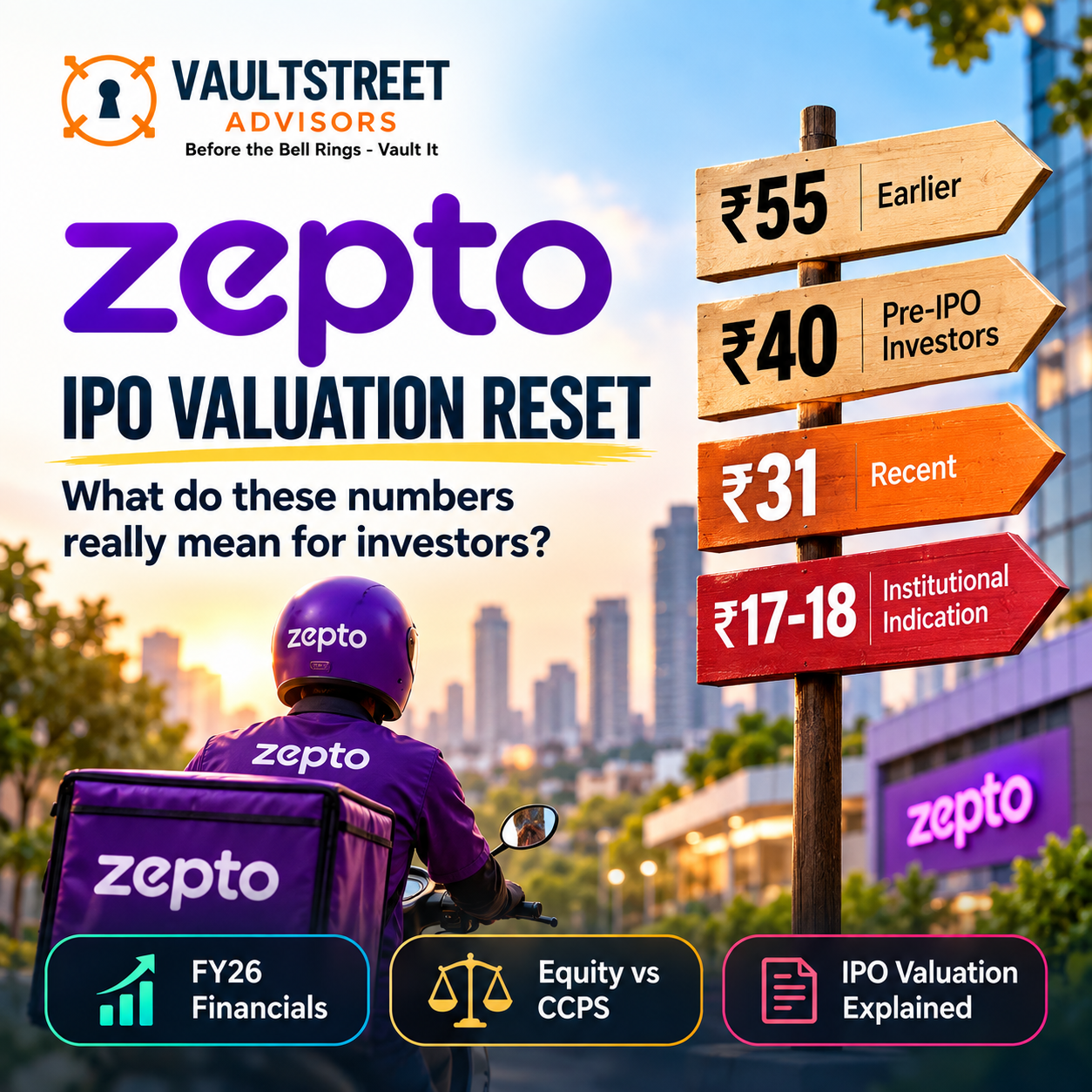
₹55.
₹40.
₹31.
And reportedly, institutional investors were willing to pay only around ₹17–₹18.
Few unlisted companies in India currently demonstrate the importance of entry valuation better than Zepto.
The quick-commerce company has more than doubled its annual revenue, processed around 64 crore orders in FY26 and built a network of 1,139 dark stores.
Yet its proposed IPO has also encountered something every pre-IPO investor should understand:
Public-market investors may value a company very differently from the unlisted market.
Zepto Equity shares are currently available in the unlisted market at an indicative price of approximately ₹31 per share through VaultStreet Advisors.
Independent unlisted-market references have recently shown equity indications around ₹30.93–₹32 as well.
But that number becomes far more interesting when compared with Zepto’s recent valuation journey.
The company was valued at approximately $7 billion in its October 2025 funding round.
By July 2026, discussions around the proposed IPO reportedly moved through substantially lower valuation levels.
And Bloomberg reported in August that SBI Funds Management and some other domestic money managers were willing to pay approximately ₹17–₹18 per share in the proposed anchor allocation, implying a valuation of roughly $2.3 billion.
That valuation gap reportedly contributed to Zepto postponing its IPO.
So what does Zepto Equity at ₹31 actually mean?
Is ₹31 cheap because the share once traded substantially higher?
Or expensive because institutional investors reportedly wanted a much lower IPO valuation?
And perhaps most importantly:
Are investors even comparing the correct Zepto security?
Because Zepto Equity and Zepto CCPS are not the same instrument.
Let us unpack the entire story.
Zepto Equity Share Price: Key Numbers at a Glance
| Particular | Current / Reported Position |
|---|---|
| VaultStreet indicative Zepto Equity price | Approx. ₹31 per share |
| Security | Equity Shares |
| Equity ISIN | INE143401029 |
| Face Value | ₹5 |
| Recent independent unlisted-market indications | Around ₹30.93–₹32 |
| Reported March 2026 unlisted level | Around ₹55 |
| Price paid by certain prominent pre-IPO investors disclosed/reported | Approx. ₹40.13 |
| Reported institutional anchor indication | Approx. ₹17–₹18 |
| Last major private funding valuation | Approx. $7 billion |
| Reported lower IPO valuation discussions | Approx. $2.3–$3 billion |
| Reported proposed pre-IPO fundraising valuation | Around $4–$4.5 billion |
| IPO status | Deferred / put on hold for the time being |
Important: ₹17–₹18 was not an officially announced Zepto IPO price band. It was a reported level at which certain domestic institutional investors were willing to participate in the proposed anchor allocation.
That distinction is critical.
Zepto’s official Updated Draft Red Herring Prospectus did not specify a final IPO price band.
First: What Exactly Is Zepto?
Zepto was founded in 2021 by Aadit Palicha and Kaivalya Vohra and has rapidly become one of India’s largest quick-commerce businesses.
Its proposition is familiar to millions of urban consumers:
Order groceries, household products, personal-care products, electronics and other everyday items through an app and receive them rapidly from nearby dark stores.
But behind that simple customer experience sits an enormous logistics network.
As of March 31, 2026, Zepto operated:
- 1,139 dark stores
- Across 66 cities
- Serving nearly 4.8 crore annual transacting users
- Processing approximately 64 crore orders during FY26
The business has scaled at extraordinary speed.
The financial question is whether that scale can eventually translate into sustainable profitability.
Zepto FY26 Financials: Growth Is Huge — But So Are the Losses
Zepto’s updated IPO filing provides a fascinating picture of hypergrowth.
Revenue From Operations
FY25: approximately ₹11,110 crore
FY26: approximately ₹22,624 crore
That means revenue more than doubled in one year.
Growth: approximately 104%
Few businesses of Zepto’s size are growing at that rate.
But now look at the other side.
Net Loss
FY25: approximately ₹4,700 crore
FY26: approximately ₹5,905 crore
So while revenue increased dramatically, losses also widened.
That creates the central Zepto valuation debate.
Investors are not merely asking:
“How quickly can Zepto grow?”
They are increasingly asking:
“How much capital will be required before that growth converts into sustainable profits?”
That second question matters enormously when deciding what valuation the business deserves.
Zepto’s Q4 FY26 Numbers Show Why Investors Are Still Interested
The annual loss number tells only one part of the story.
Zepto’s March 2026 quarter demonstrated impressive operating scale.
Revenue from operations reached approximately:
₹7,498 crore in Q4 FY26
The company processed roughly:
21 crore orders during the quarter
That works out to approximately:
23.3 lakh orders per day
Orders per dark store per day increased to approximately:
2,140
compared with around 1,425 in the corresponding year-earlier quarter.
This matters because dark-store productivity is one of the most important variables in quick commerce.
The more orders that can be processed through the same infrastructure, the greater the potential for operating leverage.
Zepto therefore has a genuine growth story.
The question is the price investors should pay for it.
Zepto vs Blinkit vs Instamart: Scale Is Only Half the Story
Zepto does not operate in isolation.
Its two most important competitors are:
- Blinkit, owned by listed company Eternal
- Instamart, owned by listed company Swiggy
That gives institutional investors something extremely valuable:
Public-market benchmarks.
And this may partly explain why Zepto’s valuation has faced greater scrutiny.
Consider the FY26 operating picture.
| Metric | Zepto | Blinkit | Instamart |
|---|---|---|---|
| FY26 Orders | ~640 million | ~917 million | ~412 million |
| Dark Stores | 1,139 | 2,243 | 1,143 |
| Q4 FY26 Orders | ~210 million | ~274 million | Lower than Zepto |
| Q4 Adjusted EBITDA | Approx. ₹1,248 crore loss | Approx. ₹37 crore positive | Approx. ₹858 crore loss |
Revenue comparisons between the three need care because their business and revenue-recognition structures are not perfectly identical.
Operationally, however, one point stands out:
Zepto has achieved significant order volumes with roughly half Blinkit’s dark-store network.
That suggests strong throughput.
But profitability tells a different story.
Blinkit had already reached positive adjusted EBITDA in Q4 FY26 while Zepto continued to report substantial adjusted EBITDA losses.
That creates the valuation question institutional investors are trying to answer:
How much should investors pay today for Zepto’s future profitability?
From $7 Billion to $5.1 Billion to $3 Billion: Zepto’s Valuation Journey
This is where the story becomes especially interesting for unlisted investors.
Zepto raised approximately $450 million in October 2025 at a valuation of around:
$7 billion
Expectations surrounding the IPO subsequently helped keep interest in Zepto’s unlisted shares elevated.
But institutional price discovery began producing very different numbers.
In July 2026, reports indicated that Norges and Motilal Oswal-related interest was being discussed around:
$4.3 billion pre-money
and approximately:
$5.1 billion post-money.
Later reports suggested Zepto and investors were testing an IPO at approximately:
$2.5 billion pre-money
and around:
$3 billion post-money.
Then came an even more dramatic number.
Bloomberg reported that SBI Funds Management and other domestic money managers were willing to pay around:
₹17–₹18 per share
for Zepto’s proposed anchor allocation.
That reportedly implied a valuation of approximately:
$2.3 billion.
Compare that with the approximately $7 billion valuation of the previous funding round.
This was not a small adjustment.
It represented a substantial valuation reset.
Did Zepto Announce an IPO Price of ₹17–₹18?
No.
This distinction needs to be absolutely clear.
₹17–₹18 was not an official Zepto IPO price band.
It was a price reportedly indicated by some institutional investors during discussions surrounding the proposed anchor allocation.
Zepto’s official IPO filing did not contain a final price band.
Therefore investors should not say:
“Zepto’s IPO price is ₹18.”
The more accurate statement is:
“Reports indicated that some domestic institutional investors were willing to participate at approximately ₹17–₹18 per share.”
The IPO was subsequently deferred.
Why Was Zepto’s IPO Delayed?
The reported valuation disagreement appears to have been a major factor.
Zepto’s private-market valuation and the valuation some public-market institutions were prepared to accept were simply too far apart.
This is an extremely important lesson for anyone investing in pre-IPO shares.
Private-market valuation does not automatically become public-market valuation.
Private funding rounds involve specific investors, transaction structures, rights and circumstances.
Unlisted-market transactions involve negotiated prices and comparatively limited liquidity.
An IPO brings much broader institutional price discovery.
Those three prices can be dramatically different.
VaultStreet Advisors recently examined exactly this phenomenon in:
The lesson applies perfectly to Zepto:
Unlisted price ≠ IPO price ≠ guaranteed listing price.
So Why Is Zepto Equity Around ₹31 If Institutions Reportedly Wanted ₹17–₹18?
This is perhaps the most interesting question in the entire Zepto story.
At ₹31, Zepto Equity is:
About 44% below ₹55
but:
About 72% above ₹18.
So which price is correct?
There is no simple answer.
The ₹55 level reflected an earlier period when IPO expectations and Zepto’s previous private-market valuation were considerably stronger.
The ₹17–₹18 level reportedly reflected what certain institutions were willing to pay during anchor discussions.
₹31 reflects a current indicative unlisted-market transaction level.
They represent different participants, different dates and different market conditions.
This is why looking only at historical share prices can be dangerous.
A share falling from ₹55 to ₹31 does not automatically make it “cheap”.
Likewise, institutional investors seeking ₹17–₹18 does not automatically prove that ₹31 is “expensive”.
Price and valuation need to be analysed together with business performance.
What Valuation Does ₹31 Actually Imply?
This is much more useful than simply asking whether ₹31 “looks cheap”.
Recent market data indicates approximately 12.6 billion outstanding Zepto Equity shares.
Using that figure only as a simplified reference:
₹31 × approximately 12.6 billion shares
gives an indicative equity value of roughly:
₹39,000 crore.
But investors should treat this as an approximation rather than a definitive fully diluted valuation.
Why?
Because the final economic valuation can depend upon:
- Fully diluted share count
- Outstanding convertible securities
- ESOPs
- CCPS conversion
- Fresh capital issuance
- IPO dilution
- Changes in capital structure
This is precisely why:
A ₹31 share is not necessarily “cheaper” than a ₹500 share.
The number printed against one share tells you almost nothing without understanding how many shares exist.
Zepto Equity vs Zepto CCPS: Do NOT Confuse the Two
This is one of the most important sections of this article.
Investors searching online for “Zepto unlisted share price” may encounter very different numbers.
That can create confusion.
The reason is simple.
Zepto Equity and Zepto CCPS are different securities.
The Zepto Equity discussed in this article carries the ISIN:
INE143401029
CCPS stands for:
Compulsorily Convertible Preference Shares.
A CCPS is designed to convert into equity according to specified terms.
Therefore its quoted price cannot automatically be compared one-for-one with an ordinary equity-share price.
Before purchasing any Zepto security, investors should confirm:
- Exact security class
- ISIN
- Equity or CCPS
- CCPS series, if applicable
- Conversion ratio
- Conversion conditions
- Face value
- Number of resulting equity shares
- Rights attached to the security
- Applicable transfer and lock-in conditions
A ₹31 Equity share and a differently priced CCPS cannot simply be placed side by side and labelled “cheap” or “expensive”.
The conversion economics must first be understood.
For a detailed explanation of CCPS and other terminology used in India’s unlisted market, read:
AON, AOW, CNC, MOQ, ISIN & More: 25 Unlisted Share Market Terms Every Investor Should Know
The ₹40.13 Reference Point Is Also Interesting
There is another useful reference in Zepto’s valuation journey.
Reports based on Zepto’s prospectus disclosures noted that several prominent investors had acquired shares at approximately:
₹40.13 per share
before the IPO process.
Names reported in connection with those purchases included prominent business leaders and investors.
With current equity indications around ₹31, today’s unlisted-market price is below that reference level.
But investors should again resist a tempting conclusion:
“If sophisticated investors paid ₹40.13, ₹31 must be cheap.”
That logic is incomplete.
Those investors bought:
- At a different time
- Under different expectations
- Before subsequent institutional price discovery
- With potentially different investment horizons
- Under potentially different transaction circumstances
Their entry price is useful information.
It is not a substitute for today’s valuation analysis.
Zepto’s IPO Filing: What Was the Company Planning to Raise?
Zepto filed its Updated Draft Red Herring Prospectus in June 2026.
The proposed offering included:
Fresh Issue: Up to ₹8,010 crore
along with:
Offer for Sale: Up to approximately 113.47 million shares.
The fresh capital was intended to support areas including dark-store expansion, lease-related expenditure, technology and cloud infrastructure, marketing and other corporate purposes.
This is another important distinction for investors.
Fresh issue proceeds go into the company.
OFS proceeds go to selling shareholders.
Zepto’s proposed IPO therefore included both:
Capital for future growth
and
Liquidity for existing shareholders.
What Could Make Zepto More Valuable?
There are several genuine factors supporting Zepto’s long-term business case.
1. Exceptional Revenue Growth
Revenue from operations more than doubled in FY26.
Maintaining even a portion of that growth while improving margins could materially change the economics of the business.
2. Strong Order Density
Zepto’s Q4 order throughput per dark store increased significantly.
Higher store productivity can potentially improve unit economics.
3. Large Consumer Base
Nearly 4.8 crore annual transacting users create significant monetisation possibilities beyond basic product margins.
4. Advertising Revenue
Advertising can become a particularly attractive revenue stream because brands are willing to pay for visibility near the point of purchase.
Zepto’s advertising revenue increased substantially during FY26.
5. Expansion Beyond Groceries
Quick-commerce platforms increasingly sell:
- Electronics
- Beauty products
- Home products
- Fashion
- General merchandise
- Food and café products
A larger basket can potentially increase order values and monetisation.
6. India’s Quick-Commerce Habit
Quick commerce has evolved from an emergency grocery service into an increasingly habitual urban purchasing channel.
If that behaviour persists, the addressable market could remain significant.
What Could Go Wrong?
The Zepto story also carries substantial risks.
1. Losses Remain Very Large
A ₹5,905 crore annual net loss cannot be ignored.
Fast growth is valuable only if the business eventually demonstrates a credible pathway to sustainable economics.
2. Competition Is Extremely Strong
Zepto competes with companies backed by deep pools of capital.
Blinkit has Eternal.
Instamart has Swiggy.
Other players continue to compete for customers, locations, delivery partners and merchant relationships.
3. Public Markets May Demand Profitability
Private investors sometimes tolerate prolonged losses in exchange for rapid growth.
Public-market investors may apply a different valuation framework.
Zepto’s recent IPO experience appears to demonstrate exactly that tension.
4. IPO Timeline Risk
An IPO being discussed does not mean an IPO will happen on the expected date.
Zepto itself has now become a live example.
For a deeper discussion, read:
Pre-IPO Doesn’t Always Mean Pre-Profit: 7 Risks Investors Ignore When Buying Unlisted Shares
5. Unlisted-Market Liquidity
An investor cannot assume Zepto Equity can always be sold instantly at the displayed indicative price.
There is no NSE/BSE-style continuous order book.
Actual transaction prices depend upon available buyers, sellers, quantity and market conditions.
6. Further Dilution
Future fundraising or IPO issuance can alter the company’s capital structure and per-share economics.
₹31 vs ₹18: The Wrong Question and the Right Question
Many investors will inevitably ask:
“Why buy Zepto at ₹31 if institutions wanted it at ₹18?”
That is understandable.
But the better question is:
“What valuation does ₹31 imply today, and does Zepto’s future business performance justify that valuation?”
The ₹18 figure is valuable information.
So is ₹55.
So is ₹40.13.
So is today’s ₹31.
But none should be analysed independently.
Think of them as four valuation checkpoints:
| Reference Point | Approx. Price |
|---|---|
| Reported March unlisted-market level | ₹55 |
| Certain pre-IPO investor acquisition reference | ₹40.13 |
| Current VaultStreet Equity indication | ₹31 |
| Reported institutional anchor indication | ₹17–₹18 |
This table tells a story.
But it does not tell investors which price Zepto will eventually command in an IPO or after listing.
That will depend upon future financial performance, market conditions, investor demand and the final capital structure.
The Bigger Lesson: Institutional Investors Negotiate Hard
Zepto provides another useful lesson about India’s maturing pre-IPO market.
A famous startup name does not automatically guarantee that institutions will accept the latest private valuation.
Professional investors compare:
- Revenue growth
- Cash burn
- Unit economics
- Peer valuations
- Public-market comparables
- Profitability timelines
- Capital requirements
- Governance
- Liquidity
- Exit valuation
That is precisely why the institutionalisation of India’s pre-IPO ecosystem matters.
VaultStreet Advisors recently examined this trend in:
₹700 Crore Bet on Pre-IPO: What JM Financial’s New Fund Signals for India’s Unlisted Share Market
Institutional participation does not mean every pre-IPO company deserves a higher valuation.
If anything, institutional capital can create tougher valuation discipline.
The Listed-Market Perspective Matters Too
Once a company moves toward an IPO, unlisted investors should begin thinking more like public-market investors.
Revenue growth alone is not enough.
Neither is a famous brand.
Neither is an exciting sector.
Valuation has to be studied alongside business quality, growth and future earnings potential.
Our associated stock-broking platform, Riddhi Siddhi Share Brokers, recently examined the same principle from the IPO investor’s perspective:
IPO P/E Ratio vs IPO Returns: Does High P/E Mean Poor Returns?
The broader lesson applies equally to Zepto:
No single valuation number tells the complete story.
10 Questions to Ask Before Buying Zepto Unlisted Shares
Before evaluating Zepto Equity, investors should ask:
1. Am I buying Equity or CCPS?
Never proceed without confirming the security.
2. What is the ISIN?
For the Equity discussed here, it is INE143401029.
3. What valuation does my purchase price imply?
Don’t evaluate ₹31 merely because it is below ₹55.
4. What happens if the IPO is delayed again?
Your investment horizon should not depend upon a specific listing month.
5. Can Zepto materially reduce its losses?
This may ultimately be the most important fundamental question.
6. How does Zepto compare with Blinkit and Instamart?
Peer economics matter because public investors have listed benchmarks.
7. How much additional capital will Zepto need?
Growth that requires continuous capital infusion has different economics from self-funded growth.
8. What dilution could occur before or during the IPO?
Future issuance can affect per-share value.
9. What liquidity will I have before listing?
Unlisted shares cannot be assumed to have exchange-like liquidity.
10. Would I still want Zepto if its IPO were two years away?
This is perhaps the most revealing question.
If the investment thesis works only when an IPO happens immediately, the investor may be buying the event rather than the business.
VaultStreet Advisors View: Zepto Is Now a Valuation Story, Not Just an IPO Story
Zepto is one of India’s most fascinating private-market companies.
Its growth is real.
Its scale is real.
Its consumer adoption is real.
And so are its losses.
But the most interesting development may actually be what happened during IPO price discovery.
The market moved from discussing a company valued around $7 billion to reports of institutional interest at dramatically lower levels.
That does not automatically make Zepto a poor business.
It demonstrates something more fundamental:
A great business story does not eliminate valuation risk.
At approximately ₹31, Zepto Equity is substantially below levels reportedly seen earlier in the unlisted market.
But that fact alone does not make ₹31 cheap.
Likewise, reported institutional interest around ₹17–₹18 does not establish Zepto’s final IPO value.
The IPO price has not been announced.
The IPO itself has been deferred.
The company’s performance can change.
Market conditions can change.
And valuation expectations can change again.
That is why VaultStreet Advisors believes investors should evaluate Zepto through three separate lenses:
Business
Is Zepto building a durable and eventually profitable quick-commerce platform?
Valuation
What market capitalisation does the current unlisted price imply?
Security
Are you buying ordinary Equity or a CCPS instrument with different conversion economics?
Get any one of those three wrong and the investment analysis can change completely.
Frequently Asked Questions About Zepto Unlisted Shares
What is the Zepto Equity unlisted share price?
As of this article, VaultStreet Advisors’ indicative price for Zepto Equity is approximately ₹31 per share. Unlisted-market prices are indicative, can vary by quantity and counterparty, and can change without notice.
What is Zepto Equity’s ISIN?
The Equity security discussed in this article has ISIN INE143401029.
Is Zepto listed on NSE or BSE?
No. Zepto is not currently listed on NSE or BSE.
Has Zepto announced its IPO price?
No. A final official IPO price band has not been announced.
Is ₹17–₹18 Zepto’s IPO price?
No. Reports said certain domestic institutional investors were willing to pay approximately ₹17–₹18 per share during proposed anchor-allocation discussions. It should not be described as Zepto’s official IPO price.
Why did Zepto delay its IPO?
Reports indicate that a substantial difference between Zepto’s valuation expectations and the valuations some institutional investors were willing to accept contributed to the company deferring its IPO.
What was Zepto’s last major private-market valuation?
Zepto was valued at approximately $7 billion in its October 2025 funding round.
How much revenue did Zepto generate in FY26?
Zepto reported approximately ₹22,624 crore of revenue from operations in FY26, more than double FY25.
Is Zepto profitable?
No. Zepto reported a net loss of approximately ₹5,905 crore in FY26.
How many dark stores does Zepto have?
Zepto reported 1,139 dark stores as of March 31, 2026.
Is Zepto Equity the same as Zepto CCPS?
No.
Equity and CCPS are different securities. CCPS convert into equity according to specified conversion terms. Investors should verify the exact security, ISIN and conversion economics before comparing prices.
Can Zepto unlisted shares be sold before the IPO?
Potentially, subject to finding a buyer and complying with applicable transfer conditions. Unlike NSE/BSE-listed shares, however, there is no continuous exchange-based liquidity.
Is Zepto’s IPO guaranteed?
No. An IPO filing or proposed IPO does not guarantee a particular listing date, valuation or successful completion of the offering.
Interested in Zepto Equity or Other Unlisted Shares?
VaultStreet Advisors tracks selected opportunities across India’s unlisted and pre-IPO market.
For investors evaluating Zepto, the first step should not simply be asking:
“What is today’s price?”
Also ask:
“Which security am I buying, what valuation am I paying, and what risks am I accepting?”
For current indicative availability and quantity in Zepto Equity and other selected unlisted/pre-IPO shares:
VaultStreet Advisors
📲 +91 91379 69859
Before the bell rings… Vault it!
Important Disclaimer
This article is for educational and informational purposes only and does not constitute investment advice, a research recommendation, an offer, solicitation or recommendation to buy, sell or hold any security.
VaultStreet Advisors is a boutique distributor/facilitator in the unlisted and pre-IPO market and is not a SEBI-registered investment adviser. Prices and quantities mentioned for unlisted securities are indicative, may vary between counterparties and transaction sizes, and are subject to change without notice.
Unlisted and pre-IPO securities involve significant risks, including valuation risk, liquidity risk, business risk, dilution risk, transfer restrictions and uncertainty regarding the timing, pricing or completion of any proposed IPO.
Reported IPO valuation discussions and institutional price indications referred to in this article are based on publicly available media reports and should not be interpreted as an officially announced IPO price or guaranteed future valuation.
Investors should independently verify the exact legal entity, ISIN, security class, conversion terms where applicable, financial information, transaction documentation, taxation, lock-in requirements and other relevant information before investing, and should consult a SEBI-registered investment adviser or other qualified professional where appropriate.