


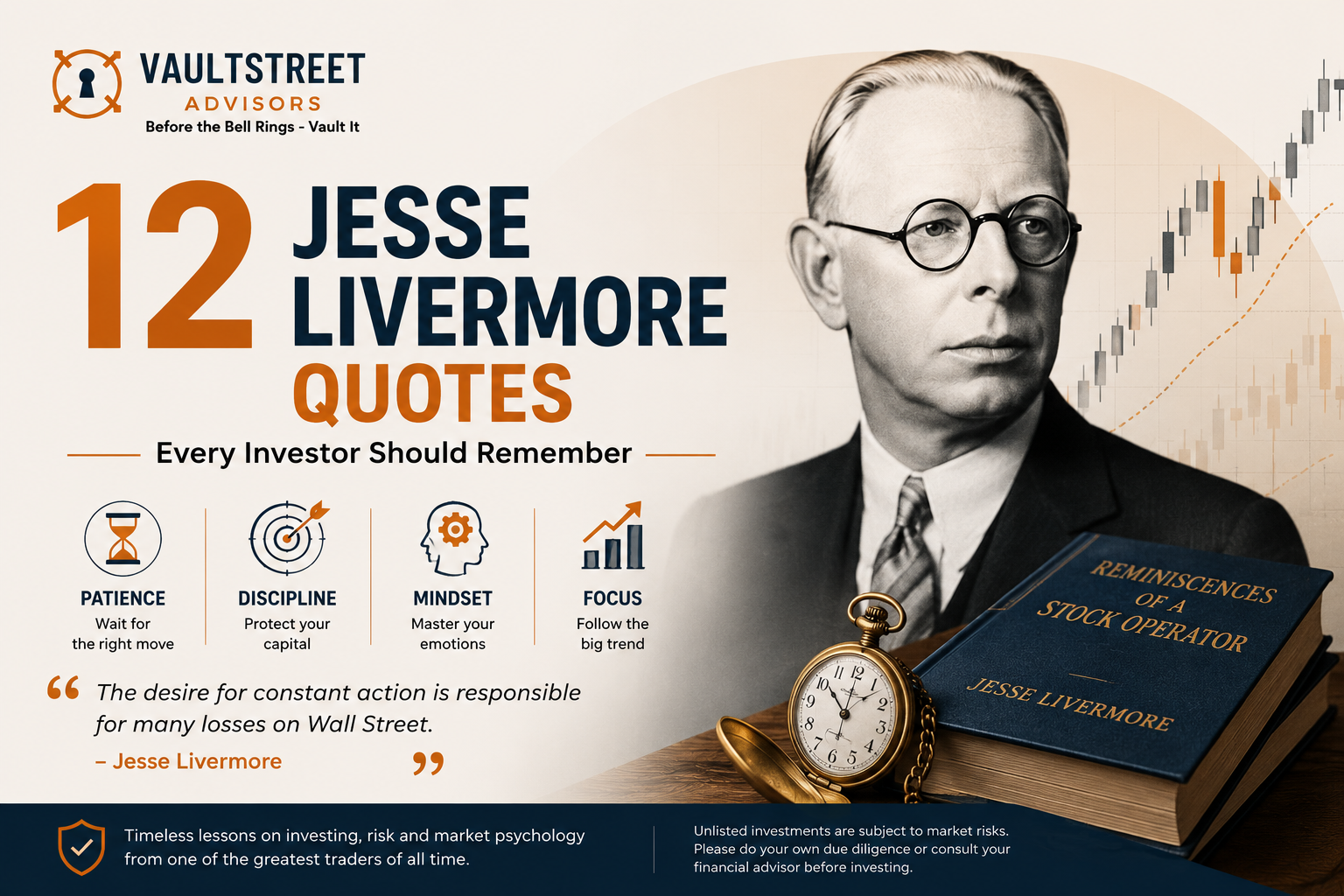
Markets have transformed dramatically over the past century.
Trading has moved from ticker tapes to smartphones. Information that once took hours or days to reach investors now travels across the world in seconds. Algorithms execute millions of trades, financial data is available instantly, and investors have access to more information than ever before.
Yet one thing has hardly changed:
Human behaviour.
Fear. Greed. Impatience. Ego. Hope. FOMO.
These emotions influenced investors a hundred years ago, and they continue to influence investment decisions today.
That is why the observations attributed to legendary market speculator Jesse Livermore remain remarkably relevant.
His life was also a reminder that market success is not simply about finding winning trades. Risk management, discipline and protecting capital matter just as much.
Here are 12 Jesse Livermore quotes worth remembering — and the lessons today’s investors can take from them.
1. “It never was my thinking that made the big money for me. It always was my sitting.”
The Lesson: Patience Can Be More Valuable Than Activity
Investors often feel that making money requires constantly doing something.
Buy. Sell. Switch. Trade. Book profits. Find the next opportunity.
But once you have identified the right opportunity at the right valuation, excessive activity can actually work against you.
Successful investing sometimes requires something far more difficult:
Waiting.
A fundamentally strong business may need years to realise its potential. Constantly reacting to short-term price movements can prevent investors from participating in the larger wealth-creation journey.
The lesson is simple:
Finding an opportunity matters. Giving it enough time to work can matter even more.
2. “There is only one side to the stock market — the right side.”
The Lesson: Don’t Fall in Love With Your Market View
Investors often describe themselves as bullish or bearish.
But markets have no obligation to agree with either view.
Being permanently bullish can make investors ignore risks. Being permanently bearish can make them miss opportunities.
Good investing requires the ability to change your opinion when the facts change.
The objective isn’t to prove that your original prediction was correct.
The objective is to make rational decisions based on the information available today.
3. “A loss never bothers me after I take it. I forget it overnight.”
The Lesson: Accept Mistakes Before They Become Expensive
Nobody gets every investment decision right.
The real difference often lies in what investors do after discovering they were wrong.
A common behavioural trap is refusing to accept a mistake because selling would convert a paper loss into a realised loss.
This can lead investors to hold fundamentally deteriorating investments simply because they want to recover their original purchase price.
But the market does not know your purchase price.
Ask instead:
“If I did not already own this investment, would I buy it today?”
If the answer is no, your original entry price should not become the reason for continuing to hold it.
4. “Nobody can give me a tip that will make more money for me than my own judgment.”
The Lesson: Never Outsource Your Conviction
Markets are full of tips.
Friends recommend stocks. Social media produces multibagger ideas. WhatsApp groups circulate “confirmed information.” Television experts offer targets.
Research and informed opinions can certainly help.
But ultimately, your money requires your judgment.
Before investing, understand:
- What the company does
- How it makes money
- Its financial position
- The valuation you are paying
- The potential risks
- Your expected holding period
- Your exit assumptions
This becomes even more important when considering unlisted and pre-IPO shares, where publicly available information and liquidity may be relatively limited.
Information can come from others.
Conviction should come from understanding.
5. “The market does not beat them. They beat themselves.”
The Lesson: Investor Psychology Can Be the Biggest Risk
Investors often blame the market for their losses.
But many losses arise from behavioural mistakes:
Buying because everybody else is buying.
Selling in panic.
Doubling down because of ego.
Ignoring valuation because of FOMO.
Taking excessive leverage.
Refusing to accept that an investment thesis has changed.
Markets are uncertain by nature.
The one thing investors can control is their own process.
Investment discipline is ultimately a form of emotional discipline.
6. “The big money was not in the individual fluctuations but in the main movements.”
The Lesson: Don’t Lose the Big Picture While Watching Every Tick
Markets move every second.
Businesses don’t.
A company’s long-term value is created through revenue growth, profitability, competitive advantage, capital allocation and execution over years.
Investors who focus excessively on daily price movements can lose sight of these larger trends.
Consider some of India’s major structural themes:
- Financialisation of household savings
- Digitalisation
- Formalisation of the economy
- Manufacturing expansion
- Rising consumption
- Growth of capital markets
- Financial inclusion
Individual stocks within these themes will rise and fall.
But understanding the larger structural movement can often be more valuable than predicting tomorrow’s market direction.
7. “Stocks are never too high for you to begin buying or too low for you to begin selling.”
The Lesson: Price and Valuation Are Not the Same Thing
A stock trading at ₹5,000 is not automatically expensive.
A stock trading at ₹50 is not automatically cheap.
Absolute share price tells investors remarkably little.
What matters is what that price represents relative to:
Earnings, cash flows, growth, assets, competitive advantages and future prospects.
This lesson is particularly relevant in the unlisted market.
Instead of asking:
“What is the price per share?”
investors should also ask:
“What valuation does this price imply?”
That small change in the question can completely change an investment decision.
8. “There is nothing new in Wall Street.”
The Lesson: Technology Changes. Human Behaviour Doesn’t.
Every generation believes its market is different.
New technology emerges.
New industries appear.
New financial products develop.
New investment narratives capture attention.
But the emotions driving markets remain remarkably familiar.
Greed creates bubbles.
Fear creates panic.
FOMO attracts investors after large price increases.
Hope makes investors hold losing positions longer than they should.
History does not necessarily repeat itself exactly.
But investor behaviour often rhymes.
Understanding market history therefore remains useful even in an era dominated by algorithms and artificial intelligence.
9. “It is what people actually did in the stock market that counted — not what they said they were going to do.”
The Lesson: Watch Actions, Not Narratives
Markets generate endless narratives.
Management teams make projections.
Analysts publish forecasts.
Investors announce expectations.
But ultimately, reality matters more than promises.
For companies, investors should track actual:
- Revenue growth
- Profitability
- Cash generation
- Debt
- Capital allocation
- Market share
- Promoter actions
- Regulatory developments
For markets, price, volume and capital flows often reveal what participants are actually doing.
Narratives can attract attention. Numbers should support conviction.
10. “Never try to sell at the top. It isn’t wise.”
The Lesson: Perfection Can Be Expensive
Everyone wants to buy at the bottom and sell at the top.
Almost nobody consistently does.
Trying to capture the exact top can cause investors to remain invested even after their original thesis or risk-reward equation has changed.
A successful investment does not require extracting the final rupee of upside.
Sometimes selling at a sensible valuation and leaving some upside for the next investor is perfectly acceptable.
Successful investing is about making good decisions — not perfect ones.
11. “The only thing to do when a man is wrong is to be right by ceasing to be wrong.”
The Lesson: Your Thesis Matters More Than Your Ego
Perhaps one of the hardest sentences for an investor to say is:
“I was wrong.”
We naturally search for information supporting decisions we have already made.
This is confirmation bias.
When contrary evidence appears, investors sometimes reinterpret it instead of reconsidering the investment.
A better process is to define your investment thesis before investing.
Then periodically ask:
Has anything fundamentally changed?
If the answer is yes, reassess objectively.
Changing your mind when facts change is not weakness.
It is risk management.
12. “The desire for constant action is responsible for many losses on Wall Street.”
The Lesson: Doing Nothing Is Also an Investment Decision
Modern investing platforms make trading almost effortless.
A few taps are enough to buy or sell securities.
That convenience can create an illusion:
Because we can trade constantly, perhaps we should.
But activity and productivity are not the same thing.
Sometimes valuations are unattractive.
Sometimes you don’t understand the opportunity.
Sometimes the risk-reward equation isn’t favourable.
Sometimes your existing portfolio requires no change.
In such situations, doing nothing can be a perfectly rational decision.
Cash is a position. Waiting is a strategy. Patience is a decision.
What Jesse Livermore’s Lessons Mean for Unlisted & Pre-IPO Investors
These principles become particularly relevant when investing in unlisted shares and pre-IPO opportunities.
The unlisted market can generate tremendous excitement when a well-known company moves closer to an IPO.
That excitement can quickly create FOMO.
Investors hear:
“IPO coming soon.”
“Limited shares available.”
“Everyone is buying.”
“Listing will be huge.”
But Livermore’s lessons suggest asking different questions.
What business am I buying?
At what valuation?
What information supports that valuation?
What are the risks?
How liquid is my investment?
What happens if the IPO is delayed?
Would I still want to own the company if there were no IPO next year?
That last question can be particularly powerful.
Because an IPO should ideally be a potential milestone in an investment journey — not the entire investment thesis.
The Three Principles That Connect All 12 Lessons
Strip away the market terminology and most of Livermore’s observations ultimately come down to three principles.
1. Patience
You don’t need to participate in every opportunity.
And when you find the right opportunity, you may need to give it time.
2. Discipline
Have a process for buying, holding and exiting.
Don’t allow market noise to rewrite that process every day.
3. Independent Thinking
Listen to information.
Study research.
Understand different viewpoints.
But eventually make decisions based on your own understanding of risk, valuation and opportunity.
Final Thought: The Market Changes. Investor Behaviour Doesn’t.
Jesse Livermore operated in a world without smartphones, online brokers, financial television, social media or algorithmic trading.
Yet investors today struggle with many of the same problems:
Fear.
Greed.
Overtrading.
FOMO.
Ego.
Impatience.
Perhaps that is why these century-old market lessons continue to feel surprisingly modern.
The tools of investing will continue changing.
Markets will become faster.
Information will become easier to access.
New opportunities will emerge.
But successful investing will probably continue to require the same qualities it always has:
Patience to wait.
Discipline to act.
Humility to accept mistakes.
And judgment to know the difference.
At VaultStreet Advisors, we believe access to an unlisted or pre-IPO opportunity is only the beginning.
Understanding the business, valuation, liquidity and risk should come before the excitement of getting in before the bell rings.
Before the bell rings… Vault it!
Disclaimer
This article is intended solely for educational and informational purposes. References to Jesse Livermore and historical market observations are used to discuss general investment principles and should not be interpreted as investment advice or recommendations.
VaultStreet Advisors facilitates transactions in unlisted and pre-IPO shares and does not provide investment advisory or portfolio management services. Nothing contained in this article constitutes investment advice, research, solicitation or a recommendation to buy or sell any security.
Unlisted and pre-IPO securities involve risks including valuation risk, liquidity risk, transfer restrictions, regulatory changes, delays or cancellation of proposed IPOs and potential loss of capital. Investors should conduct independent due diligence and consult an appropriate financial adviser before making investment decisions.